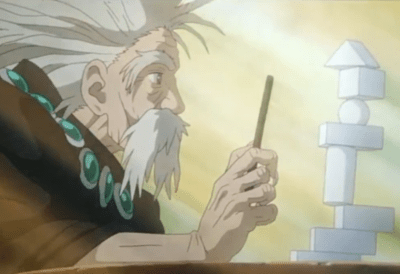
It’s been well over a year since I’ve watched Miyazaki’s The Boy and the Heron, but, in a movie filled to the brim with fantastic imagery, one image has stuck with me more than others. That image is an old man, the master of the strange alternate universe that the protagonist finds himself in, delicately balancing an array of blocks. The blocks are not stacked in any logical way. The formation is totally precarious and seems like it must fall over. A cube balances atop a sphere, a cylinder stands upright with its base leaning over the edge of the block beneath it, and so on. It’s a wonderful image, and is central to one of the point’s of the movie, which is artistic vision and vocation, and ultimately, what an apprentice can and cannot take from a master.
Mastery
The movie is deeply concerned with the idea of mastery. Our hero, Mahito, finds himself in a strange world that really is a series of worlds that all share certain symbols–most obviously, the birds who populate these worlds in different forms. These worlds are all enthralling and strange, and have interesting resonances with the real world that Mahito has left behind, such as the young pirate woman who is clearly one of the older women that Mahito knew in the real world–her spirit is preserved here as a young sailor.
The point is, we finally get the the master of this world, Granduncle, who has this precarious stack of blocks. He is the master of these worlds, and as he explains, all these worlds are variations dictated by this stacking of blocks. This master is the creative, and the blocks are his “obsessions,” the things that he can’t let go of, that come back time and time again in his work (think of Scorsese and you’ll think of gangsters, power dynamics, Italian Americans, etc., or of Tolstoy and you’ll think of human nature, the soul, the upper class v. the peasant class, and so on). He says they are the things that he has found in the world that are free of malice–ideas that are true, beautiful, pure. The movie seems to be saying that an artist tends to actually only have this small set of obsessions, and that, in turning these things over and over, giving them different shape, proportion, balance, and so on, an artist is able to continually create. Certainly, it is interesting to take a look at artists one loves and look for these constant obsessions. The master then isn’t necessarily one who is able to come up with completely new obsessions for each work–indeed, this would seem impossible–but is instead someone who is forever giving new form to the same set of ideas, or the same “vision”.
Apprenticeship
The master then sees Mahito and recognizes in him the artistic vocation. His initial instinct is to force his own vision, his own set of blocks, onto Mahito. But at the end of the film, the master and Mahito both recognize that this is impossible. While the master and the master’s works have given Mahito an apprenticeship in the artistic life, the artist is not one who simply reiterates what someone else said and did. The artist must strive to cultivate his own vision. From his greatest master, from whom he learned the most, Mahito only takes a single block, a single shared obsession, or obsession is the wrong word. A single, pure idea, free from malice, from which he must then go out into the world and add more blocks, all in order to complete his own vision to which he will give artistic expression. The master raises the apprentice up, only to let him go, ultimately giving him the gift of freedom to create a world entirely his own.


Leave a Reply