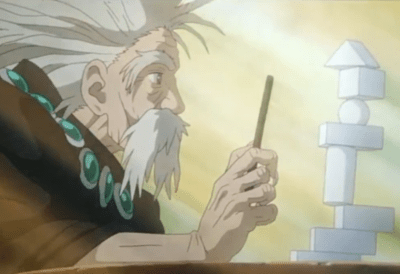
It’s been well over a year since I’ve watched Miyazaki’s The Boy and the Heron, but, in a movie filled to the brim with fantastic imagery, one image has stuck with me more than others. That image is an old man, the master of the strange alternate universe that the protagonist finds himself in, delicately balancing an array of blocks. The blocks are not stacked in any logical way. The formation is totally precarious and seems like it must fall over. A cube balances atop a sphere, a cylinder stands upright with its base leaning over the edge of the block beneath it, and so on. It’s a wonderful image, and is central to one of the point’s of the movie, which is artistic vision and vocation, and ultimately, what an apprentice can and cannot take from a master.
Mastery
The movie is deeply concerned with the idea of mastery. Our hero, Mahito, finds himself in a strange world that really is a series of worlds that all share certain symbols–most obviously, the birds who populate these worlds in different forms. These worlds are all enthralling and strange, and have interesting resonances with the real world that Mahito has left behind, such as the young pirate woman who is clearly one of the older women that Mahito knew in the real world–her spirit is preserved here as a young sailor.
The point is, we finally get the the master of this world, Granduncle, who has this precarious stack of blocks. He is the master of these worlds, and as he explains, all these worlds are variations dictated by this stacking of blocks. This master is the creative, and the blocks are his “obsessions,” the things that he can’t let go of, that come back time and time again in his work (think of Scorsese and you’ll think of gangsters, power dynamics, Italian Americans, etc., or of Tolstoy and you’ll think of human nature, the soul, the upper class v. the peasant class, and so on). He says they are the things that he has found in the world that are free of malice–ideas that are true, beautiful, pure. The movie seems to be saying that an artist tends to actually only have this small set of obsessions, and that, in turning these things over and over, giving them different shape, proportion, balance, and so on, an artist is able to continually create. Certainly, it is interesting to take a look at artists one loves and look for these constant obsessions. The master then isn’t necessarily one who is able to come up with completely new obsessions for each work–indeed, this would seem impossible–but is instead someone who is forever giving new form to the same set of ideas, or the same “vision”.
Apprenticeship
The master then sees Mahito and recognizes in him the artistic vocation. His initial instinct is to force his own vision, his own set of blocks, onto Mahito. But at the end of the film, the master and Mahito both recognize that this is impossible. While the master and the master’s works have given Mahito an apprenticeship in the artistic life, the artist is not one who simply reiterates what someone else said and did. The artist must strive to cultivate his own vision. From his greatest master, from whom he learned the most, Mahito only takes a single block, a single shared obsession, or obsession is the wrong word. A single, pure idea, free from malice, from which he must then go out into the world and add more blocks, all in order to complete his own vision to which he will give artistic expression. The master raises the apprentice up, only to let him go, ultimately giving him the gift of freedom to create a world entirely his own.
Once, at a teacher conference, a literature teacher summed up his ideas on teaching literature to me. “Literature,” he said, “is just philosophy that’s fun to read. That’s all it is.”
Being young and not particularly quick-witted–after all, I’m only addressing this now, five years later, in an essay–I used one of my stock responses when something seemed to me at once true and false, either “Huh,” or “Hmm,” or “That’s interesting.” Perhaps I used all three, one after the next. But regardless of my response, what he said has stuck with me for years as I’ve worked through my two artistic endeavors–teaching and writing fiction.
Before that point, I had tried for years to write fiction that would make people think. My process was something like this–settle on an image or story, settle on some theme, and work like hell to marry the two, like some crazed matchmaker bent on joining the two instincts of my mind. After all, I had loved literature classes in high school, and I majored in English in college, and much of what was done in those classes was trying to “understand” the texts, coming to some interpretation that one could write out in an essay or impress other students with during class discussion. When I began writing fiction, before I set the first words of a draft down, I was thinking about the interpretation of my story, what I wanted it to mean, what I wanted my reader to get out of it. And as a teacher, this is how I taught my students as well.
But at the teaching conference where I was confronted with my peer’s pithy take on fiction and philosophy, it struck me as wrong, and I found I was uncomfortable confronted by something that I could have said myself only a year or two before. A few things had begun to happen. First, I had begun reading philosophy. I was struck by wonder at hearing, on several different occasions, friends having conversations that I was simply unable to follow. I recognized that they were talking about something, perhaps that something being everything, or certainly, that something being of utmost, life-or-death importance. And yet I stood as though outside a room, unable to enter, lacking the key. So I asked them what I should read, and they recommended Plato and Boethius as well as John Paul II. So my journey, long and arduous and ongoing, began, and I found that reading philosophy, with its highly logical, propositional arguments and deep reasoning, was really not like reading fiction at all.
The next thing that began to happen was that I started reading the Bible. Or, more like it, I started having the Bible read to me by one Fr. Mike Schmitz, a testament to how technology need not be all bad. The Bible’s influence began to change and deepen my worldview, which, though it had been inspired by those who knew and loved the Scriptures, had never gone through this one true Source on its own. My faith was deepening, and I was trying to put it into practice.
Last, all the while I was attending Miami University’s MFA program, and I was learning quickly that ideological writing was not good writing. This is the kind of thing that I had heard many writers say, but that didn’t become part of my own way of being until I began to run up against how awful my fiction was when I was thinking more about themes, ideas, messages than things like plot, character, setting, details, sentence structure, and the like. My fiction was bad, and the only way to make it better became, in a creative breakthrough, to let go of the idea of writing essays disguised as stories, the “mongrel thing” that Flannery O’Connor refers to in Mystery and Manners. Suddenly, I found, I could write anything, where before, my stories by and large fell apart before I finished them, or ended dull, sterile, lifeless, lacking any mystery. I came to think that, while philosophy and fiction were connected, it was in a far different way than I had initially thought. Philosophy, or more broadly, worldview, is the stuff that stories are cut from. The fiction writer has a way of seeing, and that way of seeing comes through in the stories that they tell, through plot, character, and so on. The story is not a set of propositions that come to a logical conclusion, but rather, a series of events, of characters making decisions and facing consequences in certain times and places, that come together like a great tapestry and communicate something deeper than an idea, but rather, a whole way of seeing reality itself. The writer need not think about themes and ideas–they are working with something far more complex and mysterious that will come through all the more the less they consider it. You are dealing with worldview and also the deep mysteries of the human heart, things that philosophy struggles to deal with, particularly the latter.
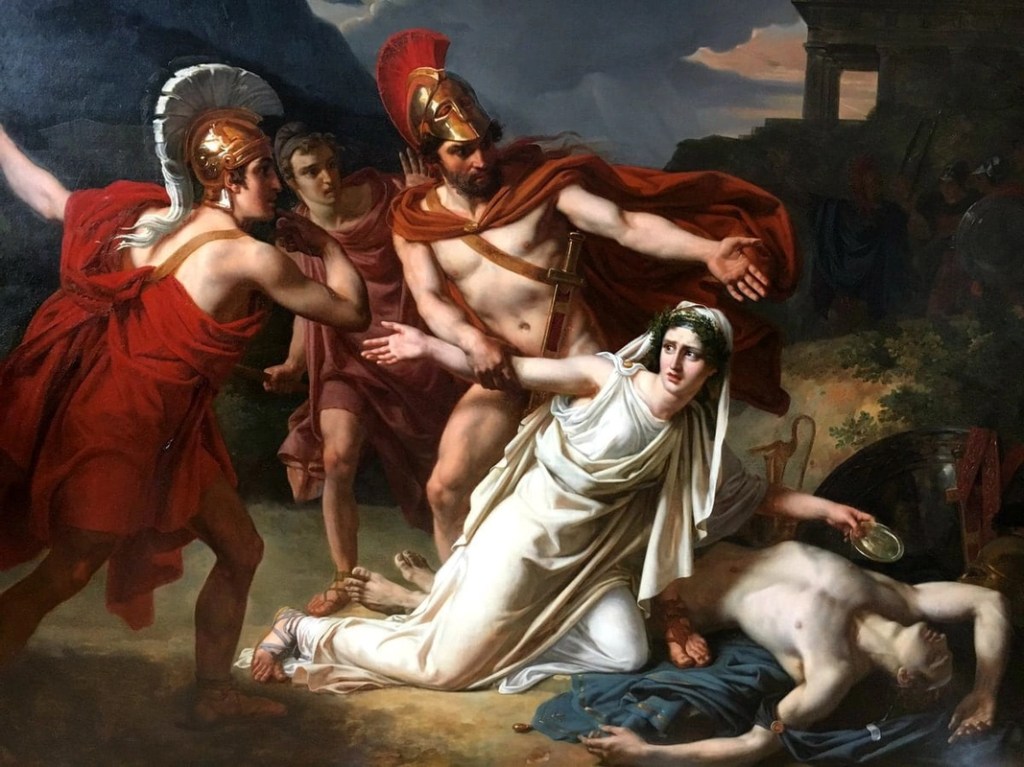
Two of the most logical, philosophical, dialectical works of art–Sophocles’ Antigone and Reginald Rose’s Twelve Angry Me–seem to actually prove this point. Teaching Antigone was a revelation, both as a writer and teacher. Antigone seems deeply philosophical and dialectical. Antigone seems to represent the Justice of the gods, true Justice, while Creon represents the justice of the state, a lowercase, flawed kind of justice. The two are at odds with each other and have several exchanges over which form of justice is knowable and must be followed. The entire thrust of the narrative is the thrust of this argument. And yet, as Antigone is sentenced to death, she gives this monologue:
“Yet he who thinks will praise what I have done. Never, were I a mother and my son Lay dead, were I a wife and he that died My husband, never had I so defied My City’s will. Ye ask me on what ground? A husband lost, another might be found; Another son be born if one were slain. But I, when Hades holds my parents twain, Must brotherless abide for evermore. Therefore I did thee honour, and therefore: Hath Creon called me mad, my brother, yea, A doer of evil. And I am led away Unwed, unsung, robbed of the love that should In right be mine and joy of motherhood. Friendless, by fate accursed, with my breath Yet warm, they cast me to the House of Death.”
Antigone doesn’t care about her logical arguments about Justice. She loved her brother. That’s all, and that’s what she was willing to risk it all for. She would not have done it for a husband, or her own child had she any. She did it for her brother, for never would she have another brother. It’s quite a strange and cruel, yet also true and lovely, sentiment, all twisted and gnarled. She seems to have used reason about divine Justice and the gods, merely as a cover-up to her true, strange, foreign intentions. Here, the mystery of the human heart is laid bare, and we can only step back in silent wonder.
A similar moment is found in Twelve Angry Men. At the end of that film, only one juror, Juror 3, is holding out with a guilty verdict. Finally, he reveals why.
“The whole thing about hearing the boy yell? The phrase was ‘I’m gonna kill you.’ That’s what he said. To his own father. I don’t care what kind of man that was. It was his father. That goddamn rotten kid. I know him. What they’re like. What they do to you. How they kill you every day. My God, don’t you see? How come I’m the only one who sees? Jeez, I can feel the knife goin’ in.”
Juror 3 here is willing to sentence a young man to death because of his own fractured relationship with his own son. His heart is on full display for us, and soon after this pivotal moment, the movie ends. We have seen the human heart laid bare. There is little else to see.
In each of these stories, and in any story worth anything, the human heart is laid bare, as is all of reality–in the movement of plot, in characterization, in sentence structure or shot framing, in how the story ends and how the story begins, all of it works together to reveal an entire way of seeing the world. This also, in part, explains why no two authors write the same story, even if the premise may be similar. The two authors have two ways of seeing the world by their two separate lives.
I am sure in future posts I will address these issues one at a time, more specifically, but for now I can say that my writing and teaching has improved that I no longer teach literature as philosophy that’s fun to read, a statement which belittles philosophy and literature. After all, why read philosophy if fiction is more fun, and where does beauty go if all that matters is logical ideas?