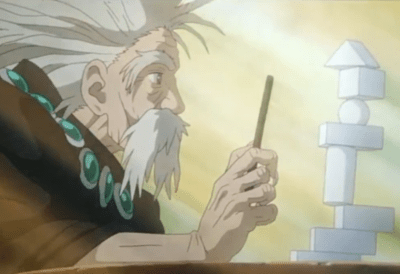
It’s been well over a year since I’ve watched Miyazaki’s The Boy and the Heron, but, in a movie filled to the brim with fantastic imagery, one image has stuck with me more than others. That image is an old man, the master of the strange alternate universe that the protagonist finds himself in, delicately balancing an array of blocks. The blocks are not stacked in any logical way. The formation is totally precarious and seems like it must fall over. A cube balances atop a sphere, a cylinder stands upright with its base leaning over the edge of the block beneath it, and so on. It’s a wonderful image, and is central to one of the point’s of the movie, which is artistic vision and vocation, and ultimately, what an apprentice can and cannot take from a master.
Mastery
The movie is deeply concerned with the idea of mastery. Our hero, Mahito, finds himself in a strange world that really is a series of worlds that all share certain symbols–most obviously, the birds who populate these worlds in different forms. These worlds are all enthralling and strange, and have interesting resonances with the real world that Mahito has left behind, such as the young pirate woman who is clearly one of the older women that Mahito knew in the real world–her spirit is preserved here as a young sailor.
The point is, we finally get the the master of this world, Granduncle, who has this precarious stack of blocks. He is the master of these worlds, and as he explains, all these worlds are variations dictated by this stacking of blocks. This master is the creative, and the blocks are his “obsessions,” the things that he can’t let go of, that come back time and time again in his work (think of Scorsese and you’ll think of gangsters, power dynamics, Italian Americans, etc., or of Tolstoy and you’ll think of human nature, the soul, the upper class v. the peasant class, and so on). He says they are the things that he has found in the world that are free of malice–ideas that are true, beautiful, pure. The movie seems to be saying that an artist tends to actually only have this small set of obsessions, and that, in turning these things over and over, giving them different shape, proportion, balance, and so on, an artist is able to continually create. Certainly, it is interesting to take a look at artists one loves and look for these constant obsessions. The master then isn’t necessarily one who is able to come up with completely new obsessions for each work–indeed, this would seem impossible–but is instead someone who is forever giving new form to the same set of ideas, or the same “vision”.
Apprenticeship
The master then sees Mahito and recognizes in him the artistic vocation. His initial instinct is to force his own vision, his own set of blocks, onto Mahito. But at the end of the film, the master and Mahito both recognize that this is impossible. While the master and the master’s works have given Mahito an apprenticeship in the artistic life, the artist is not one who simply reiterates what someone else said and did. The artist must strive to cultivate his own vision. From his greatest master, from whom he learned the most, Mahito only takes a single block, a single shared obsession, or obsession is the wrong word. A single, pure idea, free from malice, from which he must then go out into the world and add more blocks, all in order to complete his own vision to which he will give artistic expression. The master raises the apprentice up, only to let him go, ultimately giving him the gift of freedom to create a world entirely his own.
One of the most persistent battles I’ve fought as a fiction writer is against the English Major mind. What I mean is that, frequently when I write, my mind gravitates toward thinking about what the story I’m writing “means”. The meaning of a text, or of any work of art, is what we’re taught to focus on in the setting of a literature class, or in any discussion of art as a whole. We, culturally, have taken art as essentially a form of rhetoric, conceptualizing fiction as basically an essay written in code, and the student of literature, like Alan Turing, must break that enigma. Once the code is cracked, the literature reveals itself, and once its message is understood, the reader can happily move on.
This framing of fiction as rhetorical extends out to all works of art. In our own day, we make very piece of art about politics, since politics is basically all anyone talks or thinks about. So we analyze everything through the rhetorical lens of what its message is politically.
However, you’ll find that often in interviews, artists are asked what their artwork “means,” and the question, bafflingly it seems to us, leaves them at a loss for words, perplexed. They may even deny ever thinking of such things. But worse yet, as I’ve written about elsewhere, some artists are over-eager to explain their works, to the point where the explanation, the rhetorical message of the work, seems more important to them than the art itself.
The Intuitive “Yes”
Annie Dillard, in her wonderful book The Writing Life, returns again and again to images of artists who have no idea what the outcome of their art will be, what people will make of it. They describe feeling like they are simply pulling on a string to see what comes at the end of it, or, in the famous example she provides of the stunt pilot, that he is, essentially, hanging on for dear life, keeping the sun on a certain side of his face, and so on. She portrays art as process-driven, as giving in to a certain experience, regardless of the outcome.
But what exactly is this experience? George Saunders seems to give the answer in his book on craft, A Swim in the Pond in the Rain. It’s worth quoting in full, which I will pull from a piece he wrote in The Guardian that goes through the exact analogy:
A guy (Stan) constructs a model railroad town in his basement. Stan acquires a small hobo, places him under a plastic railroad bridge, near that fake campfire, then notices he’s arranged his hobo into a certain posture – the hobo seems to be gazing back at the town. Why is he looking over there? At that little blue Victorian house? Stan notes a plastic woman in the window, then turns her a little, so she’s gazing out. Over at the railroad bridge, actually. Huh. Suddenly, Stan has made a love story. Oh, why can’t they be together? If only “Little Jack” would just go home. To his wife. To Linda.
What did Stan (the artist) just do? Well, first, surveying his little domain, he noticed which way his hobo was looking. Then he chose to change that little universe, by turning the plastic woman. Now, Stan didn’t exactly decide to turn her. It might be more accurate to say that it occurred to him to do so; in a split-second, with no accompanying language, except maybe a very quiet internal “Yes.”
He just liked it better that way, for reasons he couldn’t articulate, and before he’d had the time or inclination to articulate them.
“He just liked it better that way.” Imagine giving that answer to your high school AP English teacher when they asked you why Melville spent an entire chapter talking about the whiteness of the whale instead of cutting it altogether. And yet, this seems the truest explanation of why.
Learning to See
Now, I have been listening a lot to the band Geese and Cameron Winter’s solo material. I came to them through them opening for Vampire Weekend in Philly. Something I think a lot about is their song “Long Island City Here I Come” from their recent album, Getting Killed. That whole song to me feels particularly inspired, as though they just continually said yes to stranger and stranger escalations in the music that, nevertheless, felt just right to them. One of the most hilarious and inspiring moments is when Cameron Winter sings “I’m about to kick your ass up and down this street” then proceeds to mutter “Here I come” over and over again and let out strange vocalizations for several minutes straight. It’s strange, funny, a little deranged, totally awesome, and, it would seem, deeply inspired, and inspired by a “Yes” that the entire group of musicians, or at least, some of them, must have felt when that moment first emerged.
The above-mentioned Vampire Weekend has tons of moments like this in their music too. I mean, from the jump, who would have thought of combining pop music, African rhythms, and Western classical influences into a single thing? I actually don’t believe it could be totally thought up. It had to be felt. In their song “Mary Boone,” off their most recent album, a sitar, an elegant piano riff, a hip-hop-style backbeat, some strings, and a choir, all play together at once after each chorus. It really shouldn’t work. But it totally does.
In their song “Ya Hey” (which features some chipmunk vocals that, again, really shouldn’t work, but do), they pretty explicitly reference this kind of bizarre genre-mashing in the bridge:
Outside the tents, on the festival grounds As the air began to cool, and the sun went down My soul swooned, as I faintly heard the sound Of you spinning “Israelites” Into “19th Nervous Breakdown”
Here, this very mixing of incongruous sounds is attributed to God, here represented as a DJ at a festival. They’ve touched something deep, something like reality or Being itself or God, in this mixing.
Now, I’ve spoken only to really over-the-top, explicitly “inspired”-feeling moments in song, but the point is, all of the song, every moment, must feel touched in this way, the musician must feel that “yes” at each moment of the song. Often, especially at first, it may be only the musician themself who feels the “yes”. I think here of Jack White, who, now famously, showed the “Seven Nation Army” riff to a friend, who was unimpressed. It is, in the grand pantheon of riffs, taken on its own, really not the greatest thing. And yet, White simply felt differently. He heard the riff and felt the internal yes, and pursued it to a song that is now an iconic anthem.
Similarly, you might be a musician. One of the things that may young artists do is write music that sounds like the musicians they like, but ultimately, they don’t find that satisfying. Why? Well, they chased someone else’s intuitions, vision, inspiration, “yes”, not their own. I love Jack White, but when I write songs, I stay away from riffs. They simply don’t excite me when I write them. Now, each song, story, painting, whatever, has its own craft and must be followed through on by the artist according to their own intuition, meaning one day, a riff may strike me as a “yes”. It simply hasn’t happened yet, but one should remain open to possibility. This is also why people a bit more tuned in to art are repulsed by music that sounds too much like music that came before, or like a pop-form of that music that is packaged to sell to the radio and Spotify and all that. It is clearly not the vision of the artist, but a stolen vision, and a decidedly lesser version of that original vision.
Back to Stories and Rhetoric
All this is not to say that stories, songs, and any artwork, doesn’t have meaning. I think they actually tend to have many complimentary meanings, particularly if they’ve struck beauty, being, reality, since reality can be looked at from a number of different angles to find a number of true, complimentary takeaways. Some saints were kings, some went to live in the desert. This is all only to say that these meanings are best discovered and fully worked out on the other end, often without the artist. Nothing ruins a work of art as readily and with as much good intent as pushing the meaning/message of the story so far forward that it ruins the inner workings of the art itself. I think of Chesterton’s White Horse, which is a really fun epic poem that then has to end with Alfred having a vision that the pagans will return, but with pens instead of swords! It flattens the entire poem to basically a message directed at barbaric academics, which, even if an important message, flattens the story. Or, similarly, moments like the girlboss moment in Avengers: Endgame, where for reasons inexplicable, all the female superheroes and none of the male ones have to carry the infinity gauntlet for a few moments, forcing a message into a scene at the expense of the scene itself.
As an artist, it is completely damaging to your art to be too focused on a rhetorical dimension of your work, because it will kill the “yes”. I found this moment from a Cameron Winter interview in Far Out:
“I feel like there’s nothing worse than going into a song, like ‘I have something to say with this song’.”
He continued, “Because then it’s just too much, like you’d end up writing a song that’s all about some super-specific issue – they don’t age very well, those songs. The clearer the message, sometimes, the less powerful it can come across.”
He added jokingly, “It doesn’t come across artistically. You should just make a tweet, or something.”
However, the singer-songwriter admitted, “Sometimes I do have something to say, unfortunately,” before admitting, “I get self-conscious about being too on the nose, and then if I’m not on the nose at all and it’s just like Goobledee-Girk, Lewis Caroll, horse-talk. Then I have to reverse engineer the message.”
He is exactly right. If you have something to communicate, write a tweet, or an essay. Essays are wonderful! But a song shouldn’t be an essay, a story shouldn’t be an essay.
The truth is, it seems to me, that while art can communicate truths, it does this by essentially capturing something deeper than can be expressed in, say, a string of formal logic, a speech, a debate, whatever. Those things are all well and good–all well and great, actually–but art taps into a deeper vein, where an entire fabric of truths and intuitions became a rich tapestry married to an expression given material form (a painting, a song, a narrative) that is beautiful. We can then go back and pull on some of those strings to explain those truths, but the artist is the person who is simply working their art (trying to make a painting look just right, trying to have a certain scene really capture the horror of loss, trying to give someone a character arc that makes sense, etc.). If they’ve written something “true,” something that gives them an intuitive “yes,” then, having touched the Real, it will be able to be dissected and discussed in hindsight, as it were.
Tuning into the “Yes”
The goal of the artist, then, is to tune into the “Yes”. I believe there are periods of learning where other things should be focused on. Certainly, a beginner fiction writer should learn the art of plots, character arcs, sentence structures, word choice, and so on. They should read the classics, the great works, and try to take them apart and see what makes them tick. They should workshop and learn from teachers (I’ve actually found one of the great benefits of workshopping is that readers pick up on moments where I wasn’t feeling the “Yes”–they could sense it, and could tell something about that part just didn’t work, which helped me tune into the intuitive sense more). I think people should read philosophy and try to come to a deeper understanding of art in general. But when really trying to work, trying to write, let go, lock the English Major out of the room. Lock the Alan Turing out of the room. Artmaking isn’t a code to crack, but a dance to dance. So go for the “Yes”, and revise and revise until the entire story feels like one long, protracted “YES!”
The loss of beauty leads to despair. This is the condition of our world without art and it is precisely what Tolstoy found when, confronted by the many competing definitions of beauty, he despaired of its existence and the effect this would have on his art.
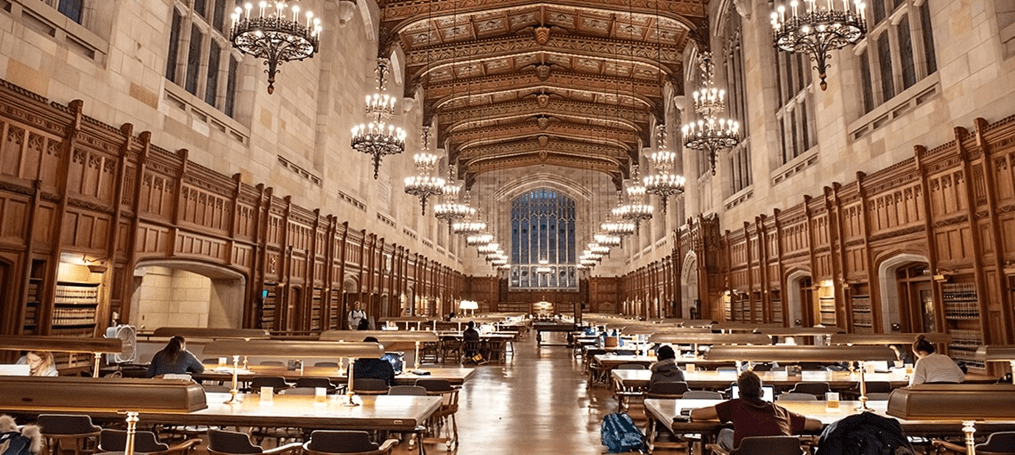
It’s actually difficult to understand this as a modern person because we are completely engulfed by ugly art. Not only art, but also anything made that could and should be beautiful is now not. As a teacher, I think a lot about classrooms and school buildings, with their low ceilings and intense fluorescent lights, their walls covered with ugly patterns of ugly-colored paint, their tiled floors. Where classrooms and academic buildings once, at their best, were designed to look like this, the University of Michigan Law School library:
they now looks like this, a typical contemporary library at the same university, Michigan, as the above library:
What is the difference between these two rooms? Why does one room, with its deep brown woods, its vaulted ceiling, its chandeliers, make one think of how pleasant it would be to study, how good it is to learn and commit oneself to learning, while the other, with its low ceilings, trademark fluorescent lights, ugly mass-produced tables and chairs, and puke green walls, make you feel ill-at-ease? The difference, I would argue, is that one was designed merely for its function (both are places of learning, broadly-speaking), while the other is designed for that same function but also for beauty. When beauty is not considered, ugliness and despair follow. You would want to leave the modern classroom as soon as the class period ended. You would want to stay inside that library until they forced you out. Why is that? What exactly is beauty, and what effect does it have on the human person?
What is Beauty?
Let’s return to Tolstoy. In his work, What is Art?, Tolstoy examines the myriad definitions of beauty, and, despairing of finding common ground between them, tosses up his hands and decides that beauty does not exist. He has become trapped within the cave. This loss of the reality of beauty leads Tolstoy to conclude that, if fiction isn’t simply for writing something beautiful, which it can’t be, then it must be for teaching moral lessons, and, since beauty doesn’t exist, he lambasts works of the past that don’t possess a strong moral lesson, such as his own masterpieces War and Peace and Anna Karenina, as well as works by Beethoven, Shakespeare, Dante, and many others besides.
It’s important to note that, just because there are many competing definitions of “beauty,” this in no way means that beauty does not exist. People could have many different definitions of “peanut butter”. One person might say they’re the things that you wear on your face that help you see. One might say that its peanuts ground up so finely that the oil releases, making the peanut spreadable on bread. One person might say it’s the briny water that surrounds the landmasses of planet Earth. But these sundry definitions don’t mean that “peanut butter” doesn’t exist! It only means that many of those definitions are wrong, and only one is right. The point being, many philosophers have simply been wrong about their definition of “beauty”.
Beauty is one of those things that we all know exists until that knowledge is beaten–or should I say, educated–out of us. One of the great “common sense” philosophers, St. Thomas Aquinas, defines beauty as “that which, when seen, pleases.” Now, there’s a start! This strikes one as being patently obvious, and yet, compared to the modern declaration that “Beauty is in the eye of the beholder (and, the implication being, it therefore doesn’t really exist outside of the individual’s mind),” Aquinas’ definition has the wondrous quality of actually claiming beauty does in fact exist. It is a thing outside of oneself that pleases those who behold it. Great!
But he goes further, trying to define the core of beauty. “”For beauty three things are required: this first is integrity, or perfection; (second) due proportion, or harmony; and the third is splendor.” Again, this isn’t to get too lost in the weeds, but essentially, these means that there is a core to beauty. There is a certain perfection to it (so, a song doesn’t have a sour note, or at least, no sour note/dissonance without adequate reason for it being there); a harmony (so a work of fiction will harmonize, say, on several layers–character, plot, symbolism, theme, etc), and splendor, how bright it is, how deep (so a work of fiction whose theme is, say, the nature and meaning of suffering–The Brothers Karamazov–is going to have more splendor than one whose theme is a fairly surface-level examination of love and friendship–the Harry Potter series; or, to compare apples to something more like apples, the examination of good and evil in The Lord of the Rings has far more depth and splendor than the examination of the same in the Harry Potter series).
Another way of applying this, and perhaps a better way, is to say that if a work of fiction has integrity (all of its character arcs, plot, and theme, etc. are satisfied) and harmony (all these things work in conjunction with one another, with nothing out of place), then a deep splendor, a kind of radiance, shines through–that feeling one gets of the depth of beauty when one closes Anna Karenina or The Iliad or some other beautiful work. A kind of deep joy is felt as the human heart and mind connect with the objectively beautiful, and we can deepen even more this splendor through contemplating a great work and understanding it more deeply for its richness.
And this definition gives much flexibility to art to capture some “fragment” of the beauty of God. As Jacques Maritain says in Art & Scholasticism, “There is not only one way, but a thousand and ten thousand ways in which the notion of integrity, or perfection, or achievement cah be realized. The absence of head or arm is a lack of integrity very noticeable in a woman, and slightly noticeable in a statue, no matter how disappointed N. Ravaisson may have been at not being able to complete the Venus de Milo. The least sketch of da Vinci, let alone of Rodin, is more final than the most finished of Bouguereau. And if a Futurist thinks fit to give only one eye, or a quarter of an eye, to the lady whom he is portraying, no one denies his right to do so, one only asks-that is the whole crux-that this quarter-eye be all the eye needed by the said lady ‘in the given case.’” A beautiful object captures some part of beauty particular to itself, yet still in relation to that eternal beauty of the Divine Being. There are endless characters, themes, plots, and so on that could make for a beautiful work of fiction. Beauty is larger than any one work of art, and larger than every work of art ever created or to be created put together, as beauty is ultimately God Himself.
We can see beauty most clearly, it seems, when we are merely living in reality. Nature is one of the great works of art, and simply looking up at the night sky, or standing on top of a mountain in the woods, or looking at the sun set over the ocean, is enough for us to feel beauty’s strong pull over our hearts and souls. It’s also clear to see how leads the heart to God–the beauty of these things very nearly wounds us. We are reminded of what we are made for. We feel the urge to throw away our phone, hug the people we love in such a way that they understand how deeply we love them, to live a meaningful life. It is the “wounding thing,” as Benedict XVI says. It wounds us because it reminds us of everything we so desperately, deeply want–to live in the spirit of God, to “choose Life, not Death” as Moses says to the Israelites (afterwards teaching them a song to remind them always of this choice–he knows he must appeal to their heart, and that truth found within beauty is of deepest power).
Despair
I don’t want to linger long on ugliness, but it is also noticeable when we compare it to something ugly, like modern art, which rarely possesses beauty. As such, no one is called to any sort of higher life when beholding it. To suggest that someone was put into the raptures of beauty while looking at a Jackson Pollack is absurd beyond absurdity, because it would be a total rejection of beauty and human nature.
Ugliness leads to despair because we aren’t treated as spiritual beings. As von Hildebrand writes, there was once a time where even utensils were small reminders of our humanity, our strange nature of being both matter and spirit. As Pascal says, ““Man is only a reed, the weakest in nature, but he is a thinking reed. There is no need for the whole universe to take up arms to crush him: a vapour, a drop of water is enough to kill him. but even if the universe were to crush him, man would still be nobler than his slayer, because he knows that he is dying and the advantage the universe has over him. The universe knows none of this.” We once created things that were little reminders of this simply by being useful and beautiful. Alice von Hildebrand writes of even children’s toys once being “little masterpieces,” where now children only recieve mass-produced, ugly, plastic toys. And again, a cheap plastic toy is nothing compared to the horrors of looking at an AI-generated video.
Beauty draws us in. It acts on us, and we can meet that act. Ugliness does little to act on us, certainly at our highest, most spiritual level. We must act on it to make any sort of meaning out of it.
Moreover, we used to create art that far more powerfully and directly spoke the same truth.
The ultimate end of all finite beauty is to manifest, even if in fragments, the infinite beauty of God.
– Rev. Robert E. McCall, S.J.J.
What is Art?
An old distinction is useful when thinking about the question of art. People once distinguished between the “arts” and the “fine arts”. Remnants of this distinction still exist today. My degree is a “Master of Fine Arts”. But few could really explain the difference between the arts and the fine arts, and this collapsing of distinction has led, as it always does, to not insignificant confusion.
An “art” is anything that is made. It is an art to build a house, or cook a meal, or put the sole on a shoe. It is an art to make a table, or to make the silverware that is set on the table. A “fine art” is anything that is made with the express purpose of being beautiful. A “fine art” is a “thing of beauty…a joy forever.” We have art forms that have been cultivated for millenia around this idea, from dance to theatre to poetry. From time to time, a new artform emerges, such as the novel (though there were novels in antiquity, the “modern novel” began in the 17th century, often with Don Quixote being named the first modern novel) or cinema, and the jury is still out on if video games are fine art (a question I’ll attempt to answer below as a huge fan of video games and art).
Again, the idea of primary and secondary purposes comes into play here. A spoon need only be a spoon. A good spoon is one that can ladle soup from a bowl into your mouth. A bad spoon is one that cannot. “Arts” have their primary purpose in something other than beauty. And yet, they can still possess beauty to greater and lesser degrees. Dietrich von Hildebrand, in Aesthetics, writes on this so well that I feel I should quote him in full:
[U]ntil the beginning of the nineteenth century and the triumph of the machine, culture had not yet been strangled by civilization. The expression of the spirit, the gift of giving form in such a way that was not practically indispensable, penetrated all the practical spheres of life up to that time. A knife should not only cut well; it should also possess a noble form. A chair should not only be comfortable and solid; it should also be beautiful, in fact it should sooner be a little less comfortable than be sober and prosaic. Practical life as a whole possessed an organic character and was therefore united to a special poetry of life. Related to this was the penetration of life by culture.
But as the practical life of the human being was robbed of its organic character and was mechanized and thereby depersonalized, so too the poetry of practical life was lost. The practical requirements in residential homes became a prosaic matter that was radically detached from the affective and intellectual life that we lead as persons. Railway stations, factories, airports, filling stations, and department stores were built to serve technical, neutral purposes. Cities like Phoenix and Tucson in Arizona largely consist only of such buildings, which are completely separated from the residential homes. In all these buildings, it is clear that there is no link between practical requirements and the spiritual requirements of the human being. The latter are neutralized in such a way that they no longer offer any artistic stimulus for the architectural shaping of these buildings and rooms. The building itself becomes an object of technology.
-Dietrich von Hildebrand, Aesthetics, vol. 2
So, a practical “art” can nevertheless have beauty, and yet, in our mass-produced era, they typically do not possess much. And yet, the lack of beauty in practical arts is one of the great causes of despair in our times, because things that could remind us of our spiritual natures no longer do. A spoon is just a utensil. A classroom is just a space for receiving information. A city street is just a set of lanes for getting from one ugly commercial building to the next, with the potential to see some ads along the way. We are never reminded by these things of our spiritual nature, though in a better world, we would be, and we once were.
The fine arts, on the other hand, pursue beauty above all else. If they are useful (say, a song written for a film score, or a painting to be displayed in a political building, or The Aeneid being used to secure a kind of political narrative of Rome), that is all well and good, but they do not need to be useful. They need only be beautiful.
When we see something ugly, then, we are looking at something that has fundamentally rejected its own being, rejected entering into being as much as that is possible, because it has rejected the fullness of beauty. It also rejects the audience’s being by rejecting their need for beauty and for their heart to be moved at a deep level.
The beginner fiction writer should be aware that art must lead the way to reforging the connection to the Divine through the Via Pulchritudinis–The Way of Beauty. The connection between fiction and truth will be explored in the next chapter. For now, it is worth saying that a work of fiction that has great plot, deep characterization, and great language–to oversimplify something that will be explored later–is what makes fiction beautiful.
Once, at a teacher conference, a literature teacher summed up his ideas on teaching literature to me. “Literature,” he said, “is just philosophy that’s fun to read. That’s all it is.”
Being young and not particularly quick-witted–after all, I’m only addressing this now, five years later, in an essay–I used one of my stock responses when something seemed to me at once true and false, either “Huh,” or “Hmm,” or “That’s interesting.” Perhaps I used all three, one after the next. But regardless of my response, what he said has stuck with me for years as I’ve worked through my two artistic endeavors–teaching and writing fiction.
Before that point, I had tried for years to write fiction that would make people think. My process was something like this–settle on an image or story, settle on some theme, and work like hell to marry the two, like some crazed matchmaker bent on joining the two instincts of my mind. After all, I had loved literature classes in high school, and I majored in English in college, and much of what was done in those classes was trying to “understand” the texts, coming to some interpretation that one could write out in an essay or impress other students with during class discussion. When I began writing fiction, before I set the first words of a draft down, I was thinking about the interpretation of my story, what I wanted it to mean, what I wanted my reader to get out of it. And as a teacher, this is how I taught my students as well.
But at the teaching conference where I was confronted with my peer’s pithy take on fiction and philosophy, it struck me as wrong, and I found I was uncomfortable confronted by something that I could have said myself only a year or two before. A few things had begun to happen. First, I had begun reading philosophy. I was struck by wonder at hearing, on several different occasions, friends having conversations that I was simply unable to follow. I recognized that they were talking about something, perhaps that something being everything, or certainly, that something being of utmost, life-or-death importance. And yet I stood as though outside a room, unable to enter, lacking the key. So I asked them what I should read, and they recommended Plato and Boethius as well as John Paul II. So my journey, long and arduous and ongoing, began, and I found that reading philosophy, with its highly logical, propositional arguments and deep reasoning, was really not like reading fiction at all.
The next thing that began to happen was that I started reading the Bible. Or, more like it, I started having the Bible read to me by one Fr. Mike Schmitz, a testament to how technology need not be all bad. The Bible’s influence began to change and deepen my worldview, which, though it had been inspired by those who knew and loved the Scriptures, had never gone through this one true Source on its own. My faith was deepening, and I was trying to put it into practice.
Last, all the while I was attending Miami University’s MFA program, and I was learning quickly that ideological writing was not good writing. This is the kind of thing that I had heard many writers say, but that didn’t become part of my own way of being until I began to run up against how awful my fiction was when I was thinking more about themes, ideas, messages than things like plot, character, setting, details, sentence structure, and the like. My fiction was bad, and the only way to make it better became, in a creative breakthrough, to let go of the idea of writing essays disguised as stories, the “mongrel thing” that Flannery O’Connor refers to in Mystery and Manners. Suddenly, I found, I could write anything, where before, my stories by and large fell apart before I finished them, or ended dull, sterile, lifeless, lacking any mystery. I came to think that, while philosophy and fiction were connected, it was in a far different way than I had initially thought. Philosophy, or more broadly, worldview, is the stuff that stories are cut from. The fiction writer has a way of seeing, and that way of seeing comes through in the stories that they tell, through plot, character, and so on. The story is not a set of propositions that come to a logical conclusion, but rather, a series of events, of characters making decisions and facing consequences in certain times and places, that come together like a great tapestry and communicate something deeper than an idea, but rather, a whole way of seeing reality itself. The writer need not think about themes and ideas–they are working with something far more complex and mysterious that will come through all the more the less they consider it. You are dealing with worldview and also the deep mysteries of the human heart, things that philosophy struggles to deal with, particularly the latter.
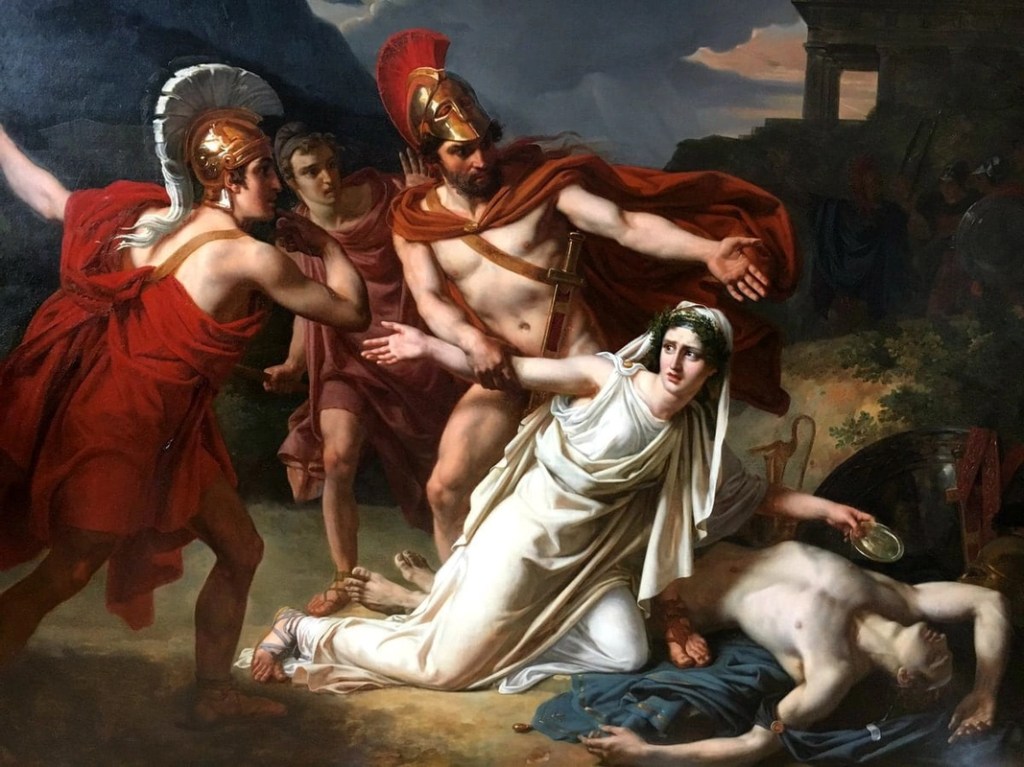
Two of the most logical, philosophical, dialectical works of art–Sophocles’ Antigone and Reginald Rose’s Twelve Angry Me–seem to actually prove this point. Teaching Antigone was a revelation, both as a writer and teacher. Antigone seems deeply philosophical and dialectical. Antigone seems to represent the Justice of the gods, true Justice, while Creon represents the justice of the state, a lowercase, flawed kind of justice. The two are at odds with each other and have several exchanges over which form of justice is knowable and must be followed. The entire thrust of the narrative is the thrust of this argument. And yet, as Antigone is sentenced to death, she gives this monologue:
“Yet he who thinks will praise what I have done. Never, were I a mother and my son Lay dead, were I a wife and he that died My husband, never had I so defied My City’s will. Ye ask me on what ground? A husband lost, another might be found; Another son be born if one were slain. But I, when Hades holds my parents twain, Must brotherless abide for evermore. Therefore I did thee honour, and therefore: Hath Creon called me mad, my brother, yea, A doer of evil. And I am led away Unwed, unsung, robbed of the love that should In right be mine and joy of motherhood. Friendless, by fate accursed, with my breath Yet warm, they cast me to the House of Death.”
Antigone doesn’t care about her logical arguments about Justice. She loved her brother. That’s all, and that’s what she was willing to risk it all for. She would not have done it for a husband, or her own child had she any. She did it for her brother, for never would she have another brother. It’s quite a strange and cruel, yet also true and lovely, sentiment, all twisted and gnarled. She seems to have used reason about divine Justice and the gods, merely as a cover-up to her true, strange, foreign intentions. Here, the mystery of the human heart is laid bare, and we can only step back in silent wonder.
A similar moment is found in Twelve Angry Men. At the end of that film, only one juror, Juror 3, is holding out with a guilty verdict. Finally, he reveals why.
“The whole thing about hearing the boy yell? The phrase was ‘I’m gonna kill you.’ That’s what he said. To his own father. I don’t care what kind of man that was. It was his father. That goddamn rotten kid. I know him. What they’re like. What they do to you. How they kill you every day. My God, don’t you see? How come I’m the only one who sees? Jeez, I can feel the knife goin’ in.”
Juror 3 here is willing to sentence a young man to death because of his own fractured relationship with his own son. His heart is on full display for us, and soon after this pivotal moment, the movie ends. We have seen the human heart laid bare. There is little else to see.
In each of these stories, and in any story worth anything, the human heart is laid bare, as is all of reality–in the movement of plot, in characterization, in sentence structure or shot framing, in how the story ends and how the story begins, all of it works together to reveal an entire way of seeing the world. This also, in part, explains why no two authors write the same story, even if the premise may be similar. The two authors have two ways of seeing the world by their two separate lives.
I am sure in future posts I will address these issues one at a time, more specifically, but for now I can say that my writing and teaching has improved that I no longer teach literature as philosophy that’s fun to read, a statement which belittles philosophy and literature. After all, why read philosophy if fiction is more fun, and where does beauty go if all that matters is logical ideas?