Video Games and “Ludonarrative Dissonance”
Much has been made in the past of the Grand Theft Auto series’ “ludonarrative dissonance.” For those who weren’t interested in theories on storytelling in games since Bioshock, this was a term coined by Clint Hocking to describe the narrative inconsistences between the story of Bioshock and the “ludic” moments where you actually played the game/what your character did in gameplay moments. One of the great examples of this dissonance is the Uncharted series, where, as noted by Jeffrey Matulef, the story (cutscenes) want you to think of Nathan Drake as a loveable rogue who is only interested in the good, where in gameplay, you kill quite literally hundreds (probably thousands) of human beings per game, always opting to kill rather than sneak past or incapacitate, something that, at the very least, should have an effect on the man, but doesn’t seem to affect him in the least.
Grand Theft Auto was also called out for this, especially with GTA IV, wherein we see scenes of our main character agonizing over the deaths of a few innocents back in his homeland while, in the game, we of course are playing Grand Theft Auto, where, even often by accident, the play character is killing many countless innocents over the course of a playthrough, and often getting into Rambo-esque encounters of escalation with law enforcement just for fun. Talk about dissonance!
Interestingly, Rockstar seems to have taken note of this, and has gone to some lengths to actually make the dissonant harmonic again. In GTA V, one of the main characters is a belligerent psychopath, so when he gives himself over to gratuitous violence in gameplay, it’s simply on par for his character. In Read Dead Redemption 2, the player character’s actions throughout the game play into a morality meter that change the way characters view you, interact with you, and ultimately, if your outcome is a hopeful one or a tragic, hopeless one. And now in GTA VI, a similar system appears to be used (though I haven’t finished the game), and it seems the story takes into account what kind of criminal you play as–a more noble thief who robs and steals basically for his family, or a violent, erratic, dangerous criminal who kills for fun. It seems that this will have consequence as the game goes on.
So ludonarrative dissonance isn’t what I want to focus on. I want to focus on good old-fashioned narrative, aesthetic dissonance.
Satire and Drama
The major dilemma, as far as I can tell, is the tension between Rockstar’s desire to write broad social satire while also, within the same narrative, to also write sincere, dramatic storylines with cinematic ambitions (or, at least, prestige TV ambitions). Their GTA games began as broad, satirical takes on American culture. What they basically do is take American stereotypes, hit them right on the nose, and blow them up to comic proportions. The people populating these games are dumb, mean, vile, vapid, idiotic Americans. They are all one or two inconveniences away from mass shootings. Their hobbies are cocaine and hookers. Their ambitions are for more cocaine and more hookers. In the world of GTA, every granny is packing a Glock and itching for you to give them an excuse to use it.
However, there has also always been an interest in real immersion in these games. Their reconstructions of cities are faithful often to a fault, potentially making purely fun gameplay suffer in favor of city streets that feel like city streets, for example, forcing you to drive miles and miles just to get to a mission where you’ll get back in your car and drive a few more miles to your destination. In GTA VI, so far, this has already been pushed to an honestly insane degree. I spent an hour on a mission (that I was rushing through) that involved me literally just hanging out in a Florida bar with my friends. That was it. For an hour. Which, for the record, is a thing that is super fun in real life and mind-bogglingly tedious in a Grand Theft Auto game. This mission, by the way, was on the tail of a mission where I rearranged furniture and played video games with a friend and another mission where I ran errands for Lucia. Again, all good things in real life, but incredibly tedious in a GTA game. But they have this commitment to immersion and realism that especially picked up in RER2 and now furthered in GTA VI.
Satire is not immersive.
With this interest in immersion came, I think, the same interest and impulse in creating an actually immersive story, one that sidestepped satire in favor of sincerity and drama. Satire is not immersive. It always makes you think of the things it’s satirizing instead of the story itself, whereas drama is immersive, and at its best makes you almost forget the real world as you engage with it. So, Rockstar wanted to make satire and drama exist in a single game. So often, from GTA IV onward, you were playing as seemingly the one actual human being in a world of cartoon characters. I think this approach worked best in the original Red Dead Redemption, where the cartoonishness of most of the people you met could be explained away by the fact that you were in the Wild West, so of course most of the people you met were insane gold prospectors, graverobbers, etc. It more or less worked there, and it also worked because the sincere, dramatic main story at the heart of the game was intensely good. A genuine Western epic about the end of the Wild West, the beginnings of totalitarian bureaucracy, the desire for freedom and a life meeting the confines of a modern capitalist civilization, all with the magnetic and compelling John Marston and Dutch caught in the terrible center.
While many loved the story in RDR2, I found it a bit less than the original, especially in its portrayal of Dutch, who in the original is a messianic figure to the group of outlaws, the only man who made sense in this crazy world, someone who gave them a hope and a dream. In RDR2, he is so clearly a ridiculous conman with no plan at all who just belligerently rambles about money and Tahiti that it removes the kind of symbolic core of the narrative. In the original, the story is memorable because it is so grand, beautiful, and tragic. In the sequel, the story is memorable largely for its memes, for one sequence where you enter into a Hatfields and McCoys type conflict, and for people’s own roleplay of Arthur as either hero or villain.
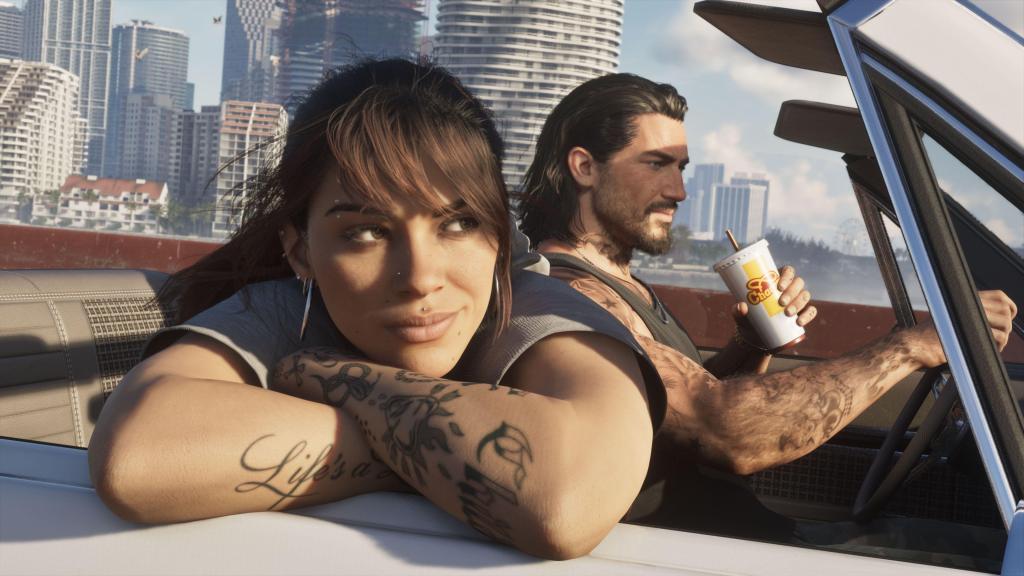
In GTA VI, the tension between satire and drama becomes unsustainable. Not for nothing, the problem of ludonarrative dissonance is still far from solved and comes back in a big way here, in spite of their honest attempts to make it work. One has to ask almost constantly that, if Jason really is just a good dude who loves Lucia and their son Tomas, why he doesn’t just get a normal job. He’s obviously a talented, hardworking guy. But we’re supposed to see his life of crime as his only way out…for some reason?
Similarly, the characters surrounding Jason and Lucia’s dramatic arc are just insane, satirical cartoon characters. For some reason, they are the only real people in a cartoon world, and it just doesn’t work.
I think the only way GTA could solve its ludonarrative dissonance issue is by either committing to a narrative like Breaking Bad where a character falls tragically by repeatedly making the wrong choices or by committing to a narrative where the main character is already super evil and we just continue in their evil, and both of these choices turning the cartoonish sidecharacters just a litte more toward grotesquery, disgusting fallen people in a fallen world, OR finally by just committing once again to being a completely absurd satire. Then, the life of crime, the evils perpetrated outside story missions, the kind of humor the game portrays when you hit a civilian with your car and they go cartwheeling through the air, etc. would all make sense. No matter how good of a person I want Jason (or Arthur Morgan in RDR2 for that matter) to be (fixing his house for Lucia, running chores for her, using my car instead of stealing others, or for Arthur, helping people and acting nobly), the game still careens always toward mayhem, violence, crime, destruction, etc. It can’t escape what it is. Maybe it should stop trying to.
A Final Way
I think there is one way GTA could have its cake and eat it too. Really, two ways, but basically both are two sides of the same coin. That is, don’t force the player to commit crime at all. I’m totally serious. They actually seem to already lean toward this (for example, making Jason’s car practically invincible by making repairs free so that he actually never needs to commit grand theft auto), plus all the boring, life sim type stuff. Basically, make crime itself, a life of crime, an option in the game, the other option being all the boring stuff–fixing your house, playing pool at a bar, grocery shopping. Crime is always on the wings, promising better pay, glamour, etc. But the narrative could go, if crime is not chosen, as being happy, tough but real and meaningful, a comedy that ends in happiness for our main character. Meanwhile, if crime is chosen b/c of its allure, its fun, its glamor, then ultimately, we get a tragedy and our main character’s downfall.
The other side of the coin is to have two narrative arcs, something they’ve also toyed with (GTA V and VI have multiple playable protagonists). Let’s say they are brothers. One brother lives a simple, happy life, with simple, small, life sim gameplay. Maybe if he breaks the law while driving, he gets arrested more readily, whatever. One brother lives a life of crime, with big shootouts, bank robberies, etc. The first brother has a comedic arc, the second brother a tragic arc. And once more, they would have to table their satirical impulses completely or, better yet, transform them into grotesqueries, real people whose lives and personalities have become grotesque for how they have lived them (the wannabe social media personality who tries and fails to seduce Jason in GTA VI is actually a good example of this already happening in Rockstar games–they have the knack for it).
This may seem far fetched, but it is so clearly what Rockstar is already pushing toward. They seem tired of the absurdist satire, realizing, like David Foster Wallace, that the satirist is still a bird in a cage. But they don’t quite know how to commit to telling a real story, with real weight and real consequence to real choices and a real vision of life that still is a meaningful iteration of the gameplay systems they’ve developed over decades of game creation. I offer this as a way forward. If you’re going to make me go grocery shopping in a GTA game, you better make it count.


Leave a Reply