Book Burning and Education
Literature has a tough question to answer in education, namely, why is it even there? Beyond that, why does it seem to be taken a bit more seriously than, say, an art or music class, but less seriously than the obvious pillars of modern education, math and science?
This is an ancient dilemma. In a rather infamous scene in The Republic concerning how a person is to be educated, Socrates advocates for removing poetry from his Republic. While praising Homer as clearly the greatest of all the poets, the one with the greatest command of story and language, he also criticizes Homer for his portrayal of the gods as deeply flawed, petulant, argumentative beings. Socrates’ reasons is that the gods must in fact be perfect, so to portray them in such a way is a lie. As such, Homer, in an ideal society, would be banned, lest people be led astray from true belief and right worship.
I’ve also heard that, in some medical schools, Samuel Shem’s The House of God, an irate satirical diatribe against the medical establishment, is recommended and fought against in equal measure. Those who recommend it tell people that it will open their eyes to all the horrible things about medicine, while those who oppose students reading it say that it will make these young doctors-in-training jaded about the very idea that medicine can be helpful. Notice that both sides of the argument agree on one thing–that the work will deeply affect the reader and change the way they see medicine.
And of course, every public school and liberal arts college celebrates Banned Books Week, but de Beauvoir forbid someone says they read Ayn Rand, or, far worse, says their favorite books are the Gospels, or the Letters of Paul!
It seems, like so much in our world, we hold two contradictory ideas in our minds at once with very little attention to the cognitive dissonance this should cause. On the one hand, we despise book banners and book burners of all stripes–one of the most common images of the Nazis is a large pile of books being burned. On the other hand, if a someone were to see 50 Shades of Grey at an elementary school, surely the reaction would be that this was unacceptable. The debate over whether certain LGBTQIA+ books should be included in libraries wages on throughout the country. Meanwhile, surely there are many who would and have had the same reaction to, say, a prominent display in a public school library of the Bible. Personally, when I saw a copy of a novel by musician and Hawaiian shirt enthusiast Jimmy Buffet at a used book store, my first thought was that this of all books should be burned. All this to say, we cry foul over book bans and book burnings, then move in all directions to ban books. We fear books because of the power we know them to have, and we push books because of that same power.
The Transcendentals, the Human Person, and the Power of Art
To move forward here, a quick digression is needed. Basically, we need a brief understanding of the human person and the person’s relationship to Reality or Being. To try and put simply, we can think of a person as having a mind that is made to know the Truth, a will that is made to do the Good, and a heart that is made to love the Beautiful.
So, there is truth to reality. That truth is what we come to apprehend with our mind, from 2 + 2 = 4 to the notion that Love is something like “willing the good of the other” (Aquinas). These truths shape our mind, the way we see things, the way we understand, and of course, has some effect on our will and heart (if we know it’s better for us to eat beef than ice cream, we may choose to eat meat more often, or if we know that Mozart is considered one of the world’s greatest composers, we may will ourselves to listen to him more until we love him). Ed Feser, the famous Catholic philosopher, has said that through coming to know and understand Aquinas’ famous Five Proofs, he came as an atheist to assent more and more to the Catholic faith and to love it.
There is also goodness to reality. We want to grow a good apple tree, one that bears fruit, and not a bad one that bears no fruit. Or, we see manifestly good actions, virtuous actions, and will to imitate those actions (reading how Christ lived, or even seeing how successful someone was and how they lived to get there). We “do the Good.”
And finally, we love the beautiful. This is quite obvious when you’re a teacher. Of course, a student can be an A student or an F student, knowing or not knowing just about every truth the school has to teach them, but if you make fun of math to either of them, they won’t be much moved. Now, let’s say both the A and the F student are fans of K-Pop. Should you make fun of K-Pop, you will forever lose that student, who will come to despise you, or become incredibly argumentative, or cry. K-Pop has moved their heart. In short, they love it. (Again, there are of course connections–it is highly likely that the point of an education is for the student to actually love things like history as well, it is just harder to get there).
So the power of art is namely this–it most directly and powerfully affects the heart. And the heart is the engine of the entire human person. “My weight is my love,” says St. Augustine. “Wherever I am carried my love is carrying me.”
So if you know someone who doesn’t read history or philosophy or just actively live their life and instead consider the evening news their main source of truth, you may consider that person has a weak mind, or does not know all the things that they ought to know for proper human flourishing. Indeed, that person might become a little strange, talking only of this or that bill or election, being argumentative and testy, and perhaps even the friendship ending should they find out if you voted for someone other than their candidate. In the same way, someone who hasn’t read Dante or Homer, or listened to Mozart, Bach, Beethoven, who doesn’t ever go outside to look at the sun set over the hills, a person for whom the current Top 40 (or worse, AI music) is their main source of beauty, you may consider that person has a weak heart, is not properly attuned to the beautiful, actually loves the wrong things.
Propaganda
Now, this power of art over our love (and therefore, over our entire life) comes loaded also with the fact that art presents worldviews and truth claims. We will focus mainly on truth claims here, as worldview is something that will be more deeply discussed in the next chapter, “Learning to See”.
To put it simply, especially in art that contains language, truth claims are often made. And, these truth claims, when married to art, have a powerful influence over the human person.
Three instances of truth claims within music come to me. The first is the many parties in the 2010s I attended where the song “Young, Wild, and Free” by Wiz Khalifa came over the speakers. People would sing along to the super catchy hook, swaying to the beat, somewhat mesmerized by the druggy, hypnotic spell of the song. The lyrics, of course, go
So what we get drunk?
So what we smoke weed?
We’re just having fun
We don’t care who sees
So what we go out?
That’s how it’s supposed to be
Living young and wild and free
The entire song is a kind of rebuttal to someone who might say you should not do the things that the narrators of the song do. Now, I don’t want to say that everyone who loves and heard that song did all those things that the song encouraged because the song encouraged it. That wouldn’t be true. But the song contains, essentially, truth claims, that doing drugs and partying is simply a natural and even positive part of being young. And certainly this song and the hundreds or even thousands of songs just like it have certainly had a power to convince young people that this is a completely normal–in fact, perhaps the only normal–way for a young person to act.
A second and similar instance happened at a party at a friends house, when the song “F— Donald Trump” came on the stereo. I had never heard the song–I wasn’t a very political college student, and in fact, politics really just annoyed me and seemed more pointless than anything. So imagine my surprise when, it seemed, every single person at the party chanted the hook, “F— Donald Trump,” with a kind of trancelike catharsis. I wonder how many of them could actually name a single policy of Trump’s. The point isn’t that they should either have supported or not supported Trump, but rather, that the song was a piece of political propaganda which created truth claims within art that powerfully effected the people at that party. Not to be cliche, but it was a moment that can only be compared to the “Two Minutes Hate” scene in 1984 where the crowd works themselves into a frenzy while the image of the political enemy, Goldstein, is played on a movie screen.
Tied to this second example is my final example, where, at many concerts, the music was put on pause about halfway through a show so that the musician could deliver a blistering, albeit vague, political screed to the roaring applause of the thousands in the crowd.
The broader topic of propaganda is probably too large to be covered within this series, but suffice to say, if truth claims within art can affect the individual, they can certainly affect the masses, and one should be very careful with any artform that is communicating truth claims, whether music, or movies, or even the evening news, which powerfully uses image and narrative to create entire worldviews for the audience.
Even on an individual level, whose mind hasn’t been changed by a powerful work of art? Say, a child reading To Kill a Mockingbird for the first time and recognizing the evils of racism? This isn’t a negative example–it’s actually largely quite positive. But the problem is, truth claims don’t have to be true–they can in fact be vicious lies. And a vicious lie combined with a work of art creates a brew between the head and the heart so potent that it’s not easily, if ever, undone.
The Truth of Fiction
Now fiction, as an artform built on words, has incredible powers to make truth claims. In the spectrum of fiction to philosophy, there are many works, like George Orwell’s, or C.S. Lewis’, that are something of a perfect blend between the two–great works of art that also contain many powerful philosophical points that the author seems intent on communicating to the audience and even convincing them of. Even pretty bad art can be quite convincing. No one is claiming Uncle Tom’s Cabin as anything like a literary masterpiece, but we all learned in school how important a tool it was to convince the nation that slavery was a grave evil.
The Aeneid is another example of art that is, in a sense, propaganda. It is, in effect, trying to create a unifying narrative of Rome and the Roman people as descendants of Troy and eternal enemies of Carthage. And yet it is, perhaps more importantly, a tremendously beautiful work of art.
In fiction, it is often the case with these types of philosophical works that characters symbolize or represent certain ideas. So in Black Panther, Black Panther represents Dr. Martin Luther King’s ideas of a world where race doesn’t matter and that people are all treated as brothers and sisters, while Killmonger represents Malcolm X’s more violent brand of Black superiority. In the end, Black Panther recognizes the righteousness of Killmonger’s anger while rejecting his notions that the Wakandans (themselves representative of Black people everywhere, though perhaps especially in America as an American movie) should dominate all other life on Earth. The movie–wildly entertaining, surprisingly emotional–is also making grand philosophical points through using its characters as stand-ins for ideas. Or in Beauty and the Beast, Belle represents all young women, beautiful and lovely, though perhaps a tad naive to the world and to how love actually works. Beast represents all young men, unaware of how rudely and brashly they behave and the negative effects that has on those around them. The two then fall in love and complete each other–Belle becoming a bit more realistic and centered, Beast becoming a bit more civilized and gentle. It is “a tale as old as time,” representing all true love stories.
Other times, worldbuilding is used to communicate ideas, most obviously in Utopias and Dystopias like Herland (in which a trio of men discover a utopian land of only women), 1984 (about a perfectly complete reign of an authoritarian government), and Brave New World (about a world where science and eugenics and hedonism has come to completely dictate the masses of humanity). Dante’s comedy, about the afterlife and the kind of people in it, works in a similar way. In these stories the worldbuilding does the heavy lifting on the philosophical front, and the story and characters are there to basically move through that world for the reader to see how it functions and how it affects the people within it.
Other times, the truth claims lie in the dialogue or interiority of the character, like in The Brothers Karamazov or Anna Karenina. Or it is in the narrator’s own commentary on the story, like in Middlemarch or Slaughterhouse-Five or War and Peace, which ends, preposterously, with a fifty or so page essay on the nature of history and free will. Or in Terrence Malick’s A Hidden Life, people make all sorts of verbal arguments as to why the main character, the now-sainted Franz Jägerstätter, should simply fight for the Nazis, while Franz, unable to put together any sort of logical argument, proves them wrong simply in how he lives a good life.
Or it can happen on a symbolic level. I think of a Bluey episode that is completely wordless. It is raining, and Bluey, a little girl, wants to play a completely arbitrary and childlike game out in the rain. Chili, her mom, wants to stay inside. Playing in the rain symbolically represents childlike joy, while staying inside symbolically represents adult concerns. The two are in constant conflict throughout the episode. At the end, Chili finally goes out into the rain–but with an umbrella. She is still symbolically holding on to adult cares. But, at the very end, to fully participate in Bluey’s game, she actually loses the umbrella, using it for Bluey’s game rather than to protect herself from the rain. So on a symbolic level, childlike joy and wonder is shown to be ultimately superior to adult cares and concerns. Similarly, in the novella A Christmas Carol, each Ghost looks a certain way, with each detail of their appearance having symbolic bearing on the Past, the Present, or the Future. So the Ghost of Christmas Past is a candle that flickers and constantly changes shape and appearance, like how the past can look many different ways to us at different times, a sad memory becoming ultimately a happy one because of where it led, and so on.
And of course, the truth claims always lie in the ways the story plays out, whether a character’s life ends happily or tragically, like how Rocky posits that romantic love is of higher value than worldly success, which we see when Rocky loses the fight but embraces Adrian. Or in Finding Nemo, where Marlin learns to let Nemo live his life a little more freely, while Nemo learns to respect and love his father more. Or in Brave New World, where the new world is ultimately destructive even to the best of men from the old world, essentially arguing that this new technocracy will destroy all of Western culture. Or in Macbeth and Anna Karenina, where we see that evil is in fact evil and is ultimately destructive to those who engage with it.
So fiction can contain more explicit truth claims. In the next chapter, we will see how all fiction, even seemingly non-philosophical fiction, contains a worldview, and how the truth or falseness of that presented worldview makes or breaks art.
Obviously, recognizing these things takes some level of education to learn how to spot them. But even if someone can’t spot them, they are affected nevertheless. You can probably guess the genre of music a person likes just by seeing how they dress, whether or not they could articulate the truth claims within the music they listen to. Again, this is because art affects us not just on the level of the mind, but on the deeper and even more powerful level of the heart.
Beauty and Truth
Truth, then, especially these sorts of more direct philosophical truth claims, can be seen as nearly co-primary with the attempt to make a story (or other work of art) beautiful. With that said, beauty should always be seen as the primary objective, with truth claims being sacrificed before beauty. The alternative, when beauty (or to put another way, simply good storytelling) is abandoned in order to make a point, terrible things happen. Look no further than the moment in Avengers: Endgame when, in the climax, seemingly the entire story is put aside in order to make the point, basically, that women are badass and awesome. Here, something like ten or more female superheroes converge, out of nowhere, to take the Infinity Gauntlet and carry it, a still from which is pictured below:
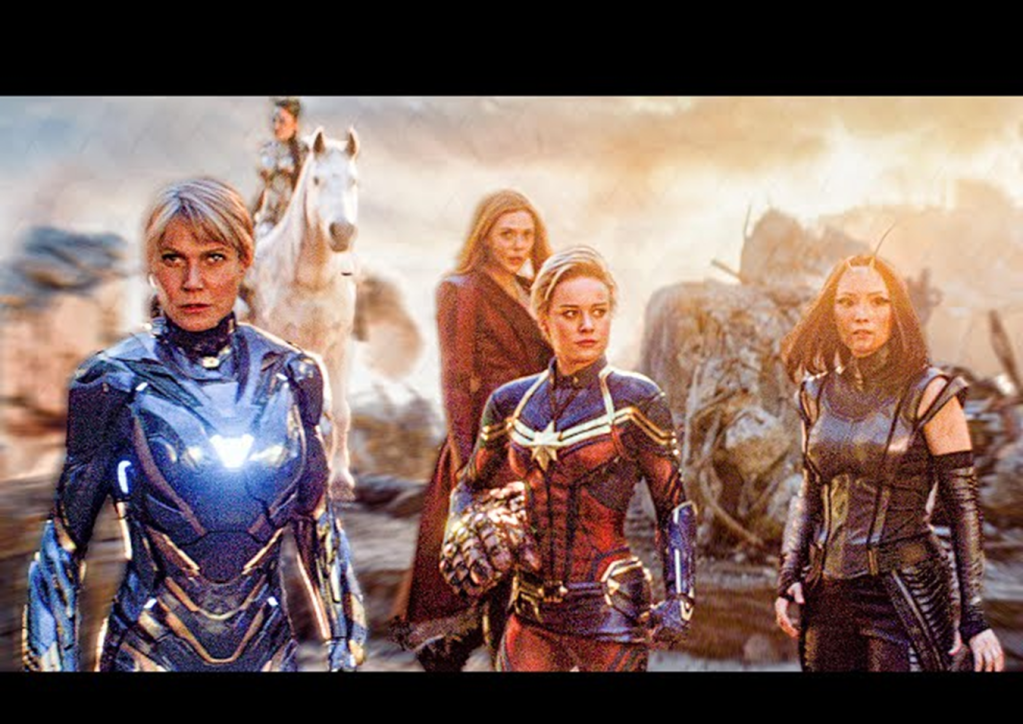
Artful storytelling has here been sacrificed for the sake of making a point, and the whole work suffers as a result. It would have been better either that this point was incorporated more naturally into the plot and character arcs, or that it was cut altogether to preserve the story itself, whether or not every single point the author wanted to make was made.
This same mistake is repeated often, and leads to art that is often called “preachy”. Meaning, namely, it has put its message, communicating its message, above telling a compelling story. So characters, plots, and so on, suffer or are manipulated for the sake of the message. Think of God’s Not Dead, infamous for its preachiness, or many famous movies and tv shows today, which push political messages or cultural messages, often doing serious harm or flat-out ruining their stories as a result. The point isn’t that any of these things have untrue messages, though certainly some or even many of them do–the point is simply that any message, even the best and truest message, will ruin a story if communicating that message takes precedence over simply telling a good story.
So a beginner should focus on beauty, knowing that truth is there as well and can be included alongside beauty. A deeper, contemplative truth that is married more naturally to beauty will be explored in the next chapter.
It is St. Thomas’ teaching that “beauty relates to a cognitive power.” But beauty is not simply the same as the true which also relates to a cognitive power. Nor is beauty the same simply as the good. The good is that which simply satisfies the appetite. The beautiful is that which gives satisfaction through its contemplation. From these factors we can formulate the following distinctions among the true, the good, and the beautiful.
-Rev. Robert E. McCall, S.J.J.
 Daniel Massett
Leave a comment