A Trip to the Museum
I was at a museum–I can’t remember which–when I stumbled upon something rather strange. The Middle Ages section of the museum was placed directly beside the Modern section with really no break between them, so that on the left you had this wonderful tapestry:
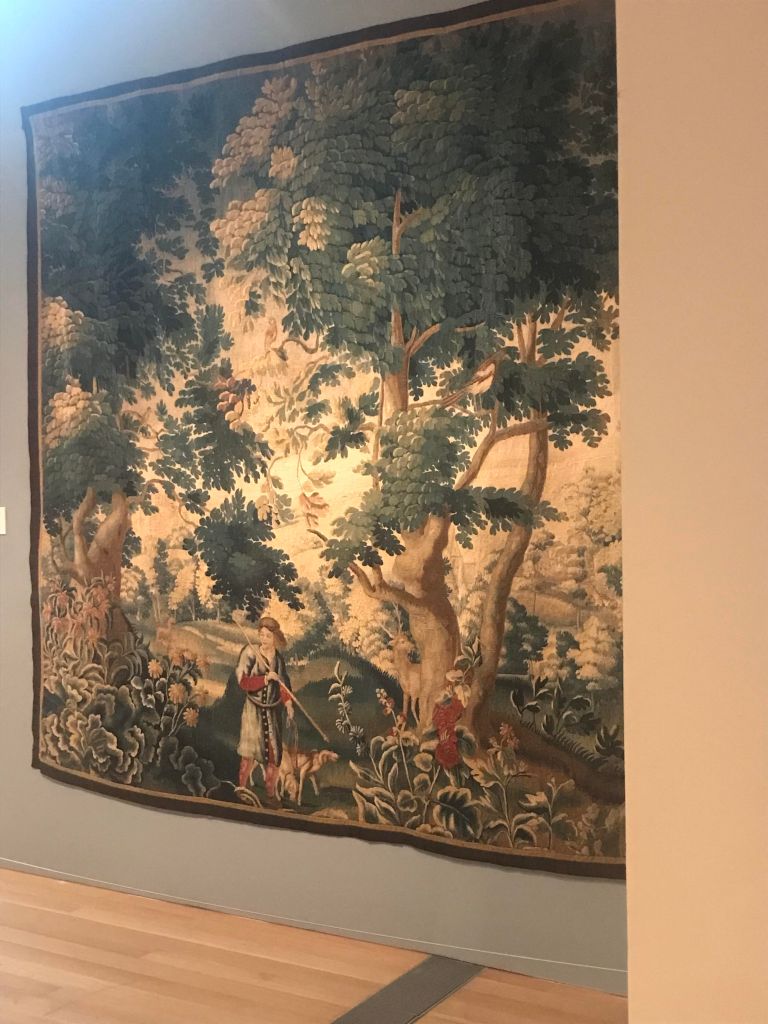
A pretty amazing work. Detailed, sharp, of its time and place but also totally pleasing to look at still today. Anyone can see the beauty of it, the skill of the artist, the care that it took to make.
Juxtaposed to this tapestry, on the right, in the modern section, the first painting one saw was this drawing of a cat:
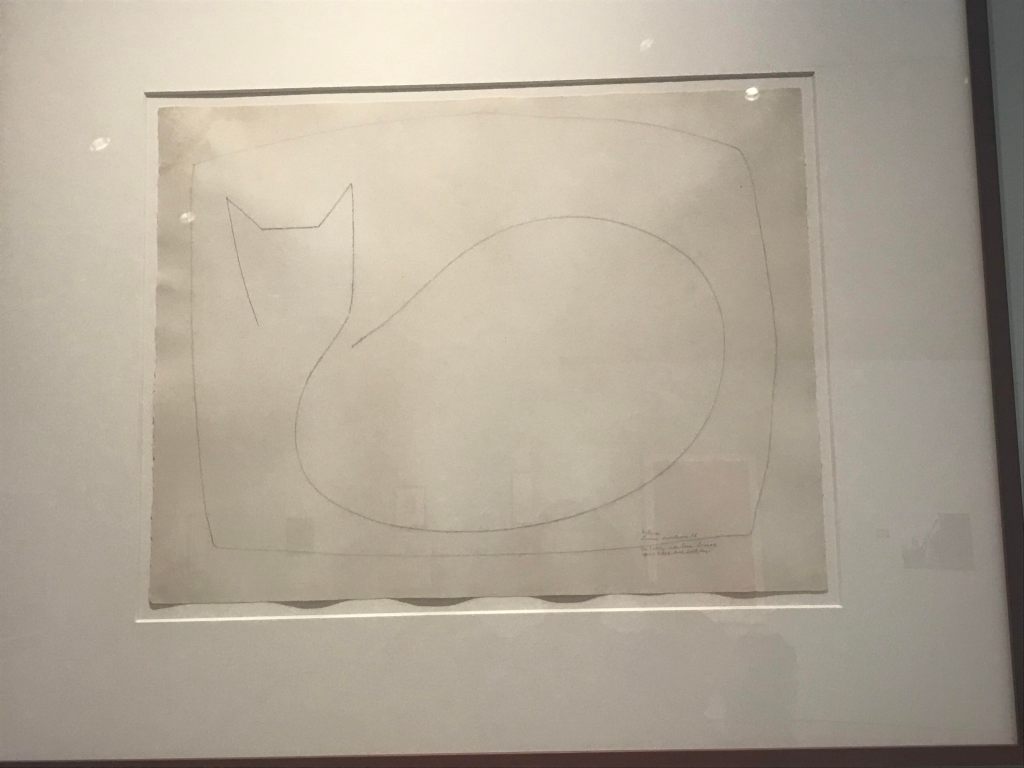
It’s difficult, when looking at this, to think of anything to say except the old cliche, found in the children’s book Olivia when the title character sees a Jackson Pollack in a museum: “I could do that in about five minutes.” Only here, one would think instead, “I could do that in about five seconds.” There’s very little good to say about it, except that it’s somewhat clever that something recognizable as a cat can be drawn with a single line, the pencil never leaving the paper. But if this were found hanging on a refrigerator, it would make much more sense than it hanging in a museum, especially next to a tapestry of such elegant design.
This example is one of many that could have been drawn of the predicament with art in our world. And it isn’t simply in museums or between the pages of a book where a modern person encounters this phenomenon. It’s in our classrooms, in our houses, in our airports, in our buildings and our city design. Where cities once were made for people to walk through, perhaps on their way to the market or the church, and were designed so that they were enjoyable to walk through because of their beauty, the modern city is essentially a place of commerce, with streets designed in rigid grids so that people who live there can easily travel from one place of commerce to another, buying and selling and producing, with very little thought given to how a person should live outside of their times of work.
Can we name this predicament? Is there a core of the problem that can be identified? Yes, indeed, it is right in front of our noses. We stare at it all day, every day (that is, when we aren’t staring at a screen instead).
We have abandoned beauty.
We have abandoned it to the destruction of art, and moreso, to the destruction of ourselves–of artists and those who wish to see art, that is to say, everyone. I don’t mean to say that these two juxtaposed works–the beautiful tapestry from the Middle Ages and the ugly drawing of the cat from the 20th century–prove that this is true. Rather, they are merely examples of something everyone who is paying attention at a museum, or in a library, or listening to music, has recognized and either spoken aloud or thought quietly in their heart of hearts. Something has gone quite wrong, indeed.
Trapped Within the Cave
This is the start of understanding how to be a writer in our world–knowing that our contemporary world has abandoned what once made art great, namely, the pursuit of capturing the Beautiful in some material form, whether that be a tapestry, a drawing, a book, a poem, a song, or any other artform. I start here because it’s where we all start, because it’s the water we are all swimming in, and unless someone is shown that they can actually swim upstream, or even hop out of the water onto dry land, the artist will simply go with the contemporary notions of art, accepting them as basic fact.
The contemporary notion is some form of this–Beauty does not exist. Beauty is in the eye of the beholder. Beauty is simply a matter of taste. Beauty is whatever makes us feel good. I will get into explorations of defining “Beauty” in the next chapter. For now, I’d like to see how we got here. This will necessarily involve some broad sweeps, but the hope is to provide a framework and some answers that, if the reader so chooses, can be explored further on one’s own. I don’t intend this to be something only PhDs can read, but rather, a beginner fiction writer.
In “The Allegory of the Cave,” Socrates lays out his basic understanding of reality. In summary, there are two levels to reality–on one level, the material world, things we can see, touch, smell, as well as things that can’t ever be known fully or with utter certainty, such as political opinions, scientific knowledge, and the like–and then a second level, a level of true knowledge of eternal, perennial truths, things like Justice and Love and Goodness and Beauty. This second level is far more important to learn and understand than the first, because it contains certain, knowable truths, and the more we learn of these things, and these immaterial truths actually affect and impress themselves on the material world. The more we come to understand this second level of things outside the Cave, the more we come to understand the nature of reality itself (the Sun, the form of the Good in the allegory, that by which all the perennial truths are seen). This special type of knowledge we call “Wisdom”.
By way of example, perhaps we see a friend in a romantic relationship. We see that they are being mistreated, abused even, and we say “That isn’t love.” Well, how is it that we come to say that? We come to say it because we have a higher understanding of what “love” is, “love” as a perennial, unchanging form, and we see that our friend, who is constantly emotionally blackmailed, does not have a relationship of love with their romantic partner. We have judged something in the cave (our friend’s relationship and whether or not it is one of love) only because we have journeyed out of the cave and gleaned some understanding of what true love really is. This is how reality works. We must have an understanding of universal truths to understand the nature of particular events and things.
This basic understanding of the two levels of reality persisted and was developed until William of Ockham and Renee Descartes. Without getting lost in the weeds, I will try to say simply and truly, that where the Ancients through the Medievals believed that we could come to understand universal truths, Ockham and Descartes started a completely new conception of reality, one which said, basically, that we cannot, that universal truths likely do not exist, and if they do, we certainly can never know them. Whether or not it’s what these men intended is not within the scope of this book. The only thing that can be said here is that it is what happened.
This philosophical shift, combined with things like the Protestant Reformation, the Renaissance, the slow shift toward focus on the individuals interior life rather than the life of the community, a slow slide away from faith, the scientific revolution which seemingly allowed us to alter the rules of reality itself, and other things besides, are what have made for Modernity and this modern predicament of having completely lost Beauty.
In our day, with the influence of Modern philosophers like Descartes, Hume, Kant, Nietzche, Sartre, and the rest, we have now arrived in a place where to make a claim like “Beauty is objective–some things are more beautiful than others” is either interpreted immediately as completely false OR is interpreted as the speaker saying “I think that beauty is objective” or “I think that this movie is better than that movie, but you may think otherwise, and that’s all ok because we are only speaking of our subjective tastes and perceptions.” Indeed, if you were to push forward and say, as I have done in the past, “No, that movie is objectively bad,” you will likely anger everyone and help no one. I don’t really recommend it. Or at least, I recommend doing so with more love and tact than that.
“Such aesthetic words as ‘beautiful’ and ‘hideous’ are employed … not to make statements of fact, but simply to express certain feelings and evoke a certain response. It follows…that there is no sense attributing objective validity to aesthetic judgments, and no possibility of arguing about questions of value in aesthetics.”
– AJ Ayer
This modern situation is what C.S. Lewis so brilliantly detailed in one of his masterpieces, The Abolition of Man. We have come to a place where, since objectivity is impossible, we largely cannot communicate about higher things. Every truth statement is interpreted by the hearer as a subjective statement. “This movie is beautiful” is interpreted as “I think this movie is really good” or “This movie moved me emotionally.” Communication is really only possible on the meeting ground of reality. Unless we can all communicate on that common meeting ground, we are merely little boats that occasionally collide, but largely are drifting on an uncaring, violent, incomprehensible sea.
Alternatively, if we cannot know universal, unchanging truths, all we can grasp at are material truths, things within the cave itself. Thus our obsession with politics, with science, with the evening news, with all sorts of lower, uncertain, or changing knowledge. Modern philosophy traps us in the cave. And it makes mankind into nothing better than lunatic cavemen trying their best to dominate one another.
The Classical and the Contemporary Artist
And this is where we find the contemporary artist. He knows for certain that beauty does not exist, is merely in the eye of the beholder. He has been told this his entire life, so it must be true. He knows that the most important aspect of art is self-expression, or uniqueness, or novelty, or political or rhetorical power. This is how he has been taught literature in school–the artist has a message that must be interpreted, and this is the core of what art is, a kind of mysterious, puzzle-like essay. He has seen (perhaps, if he has been lucky in education or curious) some examples of the Great Works and maybe finds them cold, intimidating, severe. He has seen more contemporary work, and it seems fun, approachable, unique, doable. He knows that of course art can’t be judged objectively, but he’d sure like people in mass to subjectively like his work more than they like other people’s work, but he isn’t sure how to do that. Or, he thinks his work must be politically persuasive, pushing the world closer and closer to the Socialist Utopia of his dreams. His paradigm of art and of the world are completely that of modernity. He likely doesn’t realize there is another way, one that would ask him to leave the cave for a place in the sun. Only dead fish follow the stream, and this artist is dead and not likely to find life, what with college to get into, a career to find, social media constantly updating, a new political fiasco every day, podcast after daily podcast covering said political fiasco, and on and on. He churns out work that is praised as new, exciting, a bold step forward, and that, at best, will be considered dated, hokey, and old-fashioned in another ten years, a symptom of its time, important but not loveable.
Perhaps, as an artist, or someone wondering if they are called to make art, you have felt the call of beauty in spite of being beaten over the head with the talk that beauty isn’t real. You can’t help but notice the sunset over the low fields, or the way the lines “And miles to go before I sleep,/And miles to go before I sleep” affect you, or have found that no, that movie everyone likes really is no good after all. Quite likely, you’ve loved some works of art and felt that other people must or should love the same thing. A novel that tore you open. A song that rocked your world. This is a great beginning–you are climbing out of the cave. Climb on!
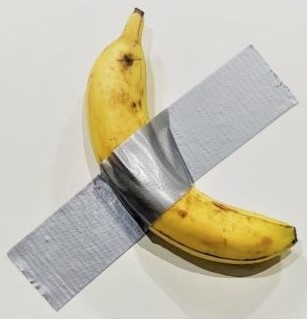
So what did the ancient and medieval artists have that the contemporary artist does not? Why can one see the tapestry at the start of the chapter and still be amazed by it while feeling totally alienated by, say, the now-infamous banana duct-taped to the wall at Art Basel? The point is this–everything. They had everything, inside the cave and out, matter and form, opinion and truth, fable and mystery, belief and faith, and we have none of it, or only parts, but not the whole. A pre-modern artist was concerned with creating something beautiful, something harmonious, something that married the past to the present, something that expressed eternity. They shared the same reality with those who would see their work, so they could be confident that, say, their painting of Christ walking on the water would be understand and appreciated in all its nuance of expression, or that their tapestry of a hunt in the woods would be recognizable to prince and peasant alike. They shared the same reality with everyone else (certainly at the height of Christendom), and their art was able to flourish as a result. It could be loved for its beauty. The artist now must be content with their placard beside their painting, which explains the inner workings of the artist’s mind when creating their incomprehensible nightmare work.
“At the sight of beauty, wings grow on the human soul.”
– Plato
Moreover, the audience then, anyone who encounters the typical modern work, is either left scratching their head and laughing in a puzzled way, or is left thinking of a political message that the art communicated to them, happy to now be convinced a bit more that their revolution is worthwhile. In an art gallery, a person has to read the placards for ancient, medieval, and modern work, because we’re completely lost in the sea of history, unaware of where we came from or what other modern people are thinking and saying. Most of the time at a museum is spent puzzling over placards. What the modern audience does not receive, what they are shut off from, what they are discouraged to do, is actively rest in the beauty of a great work of art.
I don’t mean to be overly-critical of modern artists. Many of them likely have the potential to create great work, but their philosophies, really ideologies, are like Pagan idols, and the artists have become like them. With the correct–meaning true, the only right metric–philosophy, they likely could create great works. This is the reason for including the philosophical section first. One has to get off on the right foot.
So the way forward for the beginner writer is this: recognize the modern predicament, and realize that the way forward is the way upward. We must understand beauty once again. There are many things that need to happen to right the ship of our world, but as a fiction writer, beauty and all it entails are your concern. It is your duty and your birthright.
 Daniel Massett
Leave a comment