Much has been said about the role of the violent man in the building of civilization. This is the theme meditated on in Red Dead Redemption, Logan, Seven Samurai, and Shane, among others. In these narratives, a violent man is given a violent task. This violent task, if completed, will greatly benefit civilization and civilized people. In RDR, for example, a disbanded gang of outlaws must be taken out in order for the Wild West to be settled. The great truth found in these stories is that violent men are necessary–but only for a time. When their time of violence is done, they are no longer needed, and they must be “put away” in order for non-violent civilization to flourish.
While these stories play with characters who possess unsavory traits used for the good, there is another type of story, similar but distinct, in which there is a time for heroism, perhaps of a less violent nature, that also disappears. This story is told in My Antonia, in which the title character is a pioneer woman who has to give up the civilization of her father, a cultured man from Bohemia who loves music and isn’t cut out for pioneer life. While the cultured father perishes quite early in the book, Antonia thrives, openly forsaking elements of her femininity in order to become physically strong to dig and build and care for her family. She is the feminine version of the violent man. My Antonia praises her for being the exactly right person for the exactly right time, and again, as pioneers are no longer needed, she is a type of woman who is perhaps also “put away” in favor of the cultured woman. However, she is not violent and possesses many heroic virtues. To give a final example that illustrates the spectrum, it is also the story of Lonesome Dove, about a group of former Texas Rangers who, having settled the West, no longer have anything to do. They start the novel in limbo, then take on an adventurous cattle drive to Montana, which has no cattle, knowing that, once that drive is over, America will be well and truly settled, and their lives will be over. Violence is required of them at points, but so is heroism in other forms. In the end of that story, the two main characters both fail spectacularly at becoming civilized: one refuses to acknowledge his son as his own, and the other fails to embrace romantic love and the civilizing effect of that life.
So, we have an archetype that appears again and again in stories of the person who is exactly the right person for that time and perhaps wrong for every other time. The tragic core of these stories is that, through their own actions, their way of life ceases to exist.
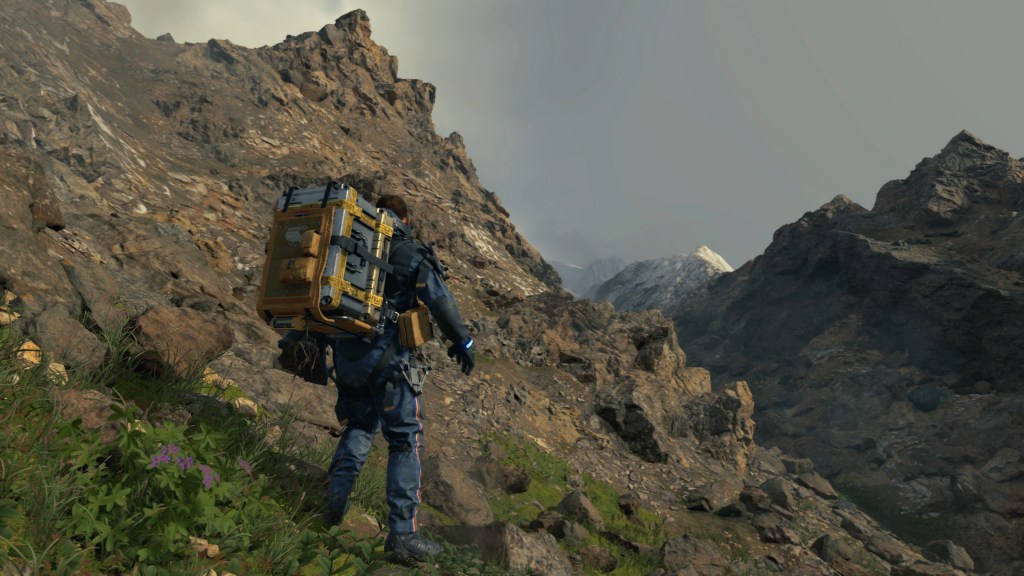
This is the story of Death Stranding. To quickly summarize, hopefully without oversimplifying, you begin Death Stranding in a world where nature rules and civilization only exists in small pockets underground. You play as Sam Bridges, whose job is to brave the wilderness of this world in order to restore civilization. The gameplay mirrors this. The world is harsh and brutal, violent and unpredictable, difficult to traverse and difficult to comprehend. You have few simple tools–ladders and climbing anchors with short ropes attached. Like the best video game stories, you experience this story through the gameplay itself far more than through the cutscenes. You cross the world, which takes courage, inventiveness, prudence, fortitude. You do right by others however you can. You are a lone traveler in a desolate world, and only your inner strength carries you through.
It is perhaps no surprise many drop the game at this point.
However, as the game progresses, you learn you can help yourself and other players by building technological structures. To fast forward, these start off simple, making their way ultimately to roads and ziplines which allow you to, ultimately, quickly cross all the brutal terrain of the game. The process of building these roads and ziplines with other players is a tremendous joy, and seeing them go up, receiving likes from grateful players and giving them in return, is totally cathartic after the tens of hours spent struggling through the game.
But, because of this, the game then grows stale. Deliveries are incredibly easy and simple. You drive the same roads over and over again. You take the same ziplines. Occasionally, you repair them. Monotony sets in, and you’ll likely get so bored of the game here that you stop playing. If not, you may complete the game, then, with nothing left to do, stop playing.
So as to not belabor the point, this seems to be a reflection on the cost of civilization. Famous and oft-repeated is the anecdote that Plato himself thought that writing, one of civilization’s greatest inventions, would impair man, specifically in his ability to remember. While most of us, least of all me, would say we should do away with writing, it’s interesting to note that I rarely talk to people about their memories, to parents and grandparents about their experiences, their path through life, their way of understanding the world. These personal and collective memories fade, and we’re often left stranded on the island of Today and of Today’s news cycle, especially if we are not remarkably well-read. It seems Plato had a point.
So much more the technologies of the day, which provide comfort and ease, but at costs that few, if any, have calculated. We are plunging headlong toward AI when we still haven’t reckoned with the potential damage television has done for our youth (or our adults, for that matter), and when we know that smartphones and social media are destroying us even as we continue to use them, like addicts with their preferred drug long after the moment of clarity and hitting rock bottom.
These technologies rob us of ourselves if we let them. My writing students who turn to ChatGPT (assuming they aren’t caught) may end up with good to even great grades, which they probably think was the point of taking a writing class. But the point was actually to learn to think deeply and articulate yourself well. As I have said to many students many times, the point of a writing class isn’t to get a good grade on essays or even to learn to only write essays. Rather, it’s to learn how to express yourself so that you can write that Best Man or Maid of Honor speech, or that card of consolation to a grieving friend, or a eulogy to a parent or spouse or child. Life is simply too precious to hand over completely to technology and civilization.
I’m not a luddite either, though I have flirted with the idea. I’m thankful for the heroes, whether Texas Rangers or soldiers in WWII or pioneer women or whoever, who made civilization possible. We need to accept and live up to that gift. And I am not a Manosphere type person who thinks men specifically need to reclaim ourselves through eating raw liver or whatever. Rather, we need to rediscover adventure. Adventure, the spirit of God and of life, comes to reach us all in our own particular station in life, even if the age of heroic adventuring of, say, Shackleton, is over (unless you’re going to get to Mars, which would be really cool). Perhaps you are a student, and the spirit of adventure is then to fully engage with academics, discover your life’s calling, find friendship and love, and so on. Perhaps you, like me, are married, and the adventure is to love your spouse through thick and thin, in good times and especially in bad times, and to have kids and raise them to be good people. Perhaps you’re a doctor, and the spirit of adventure calls you to develop yourself outside of work so that you can go back to your job refreshed instead of depressed. Perhaps you’re old, and the spirit of adventure is to continue developing your passions and to pass wisdom onto your children and grandchildren. Perhaps you’re a mother, and the spirit of adventure is to try to have a really great day with your kids. I don’t know (as a stay-at-home dad, that’s often my big adventure). All I know is that the spirit is ever-present and whispering to you. It tells you “You were not made for this” when you sit in front of the tv night after night, or doomscroll on your phone instead of listening to your friend right beside you, or when you take drugs and use people rather than get healthy and love someone. It tells you to do something even as you pop marijuana gummies and order Doordash and watch Friends reruns. You have heard this whispering voice. Heck, I have heard it when playing video games for too long rather than writing or reading.
The point is, civilization, though it does its damndest, can never fully drown out the call to adventure. And in order to live, you have to heed the call.
My last moments with Death Stranding, about a year before I thought of all this, was simply climbing a high peak in the game, looking at the sun, and then turning it off. I haven’t played it since. But my son and I have gone for many walks in the woods.
 Daniel Massett
Leave a comment