Artists, it seems, are not typically conservatives. They seem to broadly fit into a lower-p progressive category, and indeed, it can often seem that most artists by and large despise the past.
This is disconcerting as a fiction writer and something of a conservative, certainly of the lower-c order, of having a deep, abiding love for the past. I love the ways people have learned to live, the traditions, big and small, weird and wonderful, that have hung on. I love ritual and pageantry and holiday and leisure. I love that someone one hundred years ago may have read The Adventures of Huckleberry Finn as a boy and passed it down to his children, who passed it down to their children. I love that, not to get into the academic debate around the facts, a blind man named Homer spoke a poem called The Iliad thousands of years ago, and we have retold that poem ever since. It’s something like magic, something like proof that we have a soul, something like a “golden thread” connecting every single person in the West.
Yet, a basic impulse of the artist is to long for the new. This is one of the reasons, I think, that artists flock to places like New York City, where a confluence of the entire world is always smashing together and breaking apart, and life always seems to find some new fusion, some new color, some new way of being that seems to offer unlimited potential for the creative, the artist of any practice, be it painting, or writing, or cooking, or building a building, or designing a dress. This is the raw stuff of creativity. The conservative artist may become too deeply distrustful of the present or future, and is then blocked off from this basic impulse.
Or it is at least part of the artist’s basic impulse, though not all. The other part of it–it must be so–is loving the past. After all, why would you be a writer unless you had read something that moved you so deeply and so truly that you could not possibly find any other path forward in life but to write yourself? You must have loved someone else’s writing first, and then chosen to write. After all, you didn’t invent writing! You loved a writer, a work of fiction or nonfiction or poetry, and it knocked you so flat that when you arose, you had no choice but to pursue the very thing that left you horizontal. You must have loved food first, and then chosen to cook. You must have been inside one building and hated being there, then stepped inside another building and loved being there, and have been inspired to build a building yourself. You actually cannot separate yourself from that which came before. And in the same way, I find many great artists are those who stay put in their home, or whose writing stays put, and rather than examining the grand planned structures of a NYC examine the strange, well-worn yet illogical pathways of the small town, writers like Wendell Berry and Flannery O’Connor. I think of the image of Levin in Anna Karenina, who works his fields, which are a great mystery to him that he never tires of. Yet, I also love the NYC art, the bands like The Velvet Underground and The Strokes and Television, whom I saw live, and Geese, or a band like Vampire weekend, whom I’ve seen live twice, who seem to capture everything about modern life in a single song.
The conservative artist, on the one hand, seems to always be attempting to recapture some past glory, or reimagine the past to be a place everyone should love the way they love, or explore some well-worn form. The progressive artist, on the other hand, seems to always be attempting to make the future through their art, either by creating utopias like those they would like to see, or at least, creating our world or future worlds or past worlds with progressive, utopian elements, or by ruthlessly criticizing our own contemporary world. Of course, there is much to dream of for the future, and there is much to be said for imagining into the past or criticizing the present, and it’s not a totally neat distinction, though it seems the distinction is there nevertheless.
The issue, on both sides of the argument, is that we are looking at it all the wrong way. We must, like some strongman or superhero, straddling an enormous chasm, embracing two things which threaten to tear them apart, embracing both these impulses and looking beyond them. As Bob Dylan, always one to follow his own North Star, said at a political award ceremony as each side tried to claim him as their own, “To me, there is no Left or Right. There is only Up or Down, and I’m on my way Up.” What can this mean except that our own distinctions between Left and Right, progressive and conservative through the lens of politics or culture at large, are faulty in that neither constitute a real, three-dimensional, total worldview. They only mark what our two-party political system is pragmatically attempting to enact at any one place and time. This political worldview leaves no room for things too big for either party, like mystery, and love, and capital-T Truth, and capital-B Beauty, and right and wrong, and the rest.
So, as with all things, the only way out is through.
One has to read deeply and thoroughly–perhaps someone can enjoy Goethe and Geese–and also try to live their lives the best they can. This seems to be good advice for any person, and it is good advice for the writer specifically. Ideological thinking is one of the great generators of bad art. Ideological thinking is a combustion engine, and it fuels the writer down well-worn roads, none of which can will ever lead to the heights needed to write something that truly sees the whole picture.
These roads lead only to specific sights, dependent on the place and time.
Progressive art, at this moment, seems to lead only to sights of institutional racism, the evils of capitalism, the evils of men, the virtues of manlike women, the virtues of womanish men, the beauty of androgynous men and masculine women, the idea that all systems are only means of power, the benefits of throwing off the past, the destruction of old forms and the celebration of the new (how many short stories do we read that are in the form of a PowerPoint, or a job application, or a series of emails, or a baby name book, or a summary of every episode of Law & Order: SVU), and so on. We get art like Moonlight, or James, or The Rings of Power, or Everything Everywhere All At Once, or One Battle After Another. You’ll find that the progressive art considered great is always the thing made this year, or maybe a year before that, and it’s best if no one knows about it and it loses it’s cool when people do know.
Conservative art shows us the familiar sights of pure good triumphing over pure evil, the virtues of manly men and womanly women, arguments between Christianity and Atheism where Christianity always triumphs, the benefits of Capitalism, the pitfalls of Communism, the endurance of old forms, and so on. We get art like God’s Not Dead, or The Chosen or “anything by C.S. Lewis.” You’ll find that most great art people call conservative was made at least 100 years ago, though the further into the past, the better. Of course, this means that some progressive art eventually becomes conservative art as the passage of time makes the past’s revolutions seem quaint and comforting and familiar.
In fiction, all the settings, characters, plot, and the rest must fall in with one of these two visions, these woefully incomplete visions, and the art must put forward these rhetorical ideas often at the expense of the beauty of the art itself.
But there is another way! There must be another way! And there must be another way because the world is so much bigger than either of these visions, because the depths are so much deeper, because the heights are so much higher, because reality is so much more real! The great Tracy K. Smith pointed to this in a small Q&A I attended in college, where she said something to the effect of “Art is not the place for your opinions, the opinions you might share at a dinner party. It is a place beyond that.” Yes, the place is Beauty, a place of deeper, abiding vision, married to Truth, a place that does not grow old but ever-young, a place always waiting to be discovered a new and whose fields and mountains and prairies and cities and castles and desserts and chasms are always to be discovered by the artist who dares journey beyond and the audience who dares go along with them. Only with this can artist continue to meet their art in the present moment, where past and future and truth all collide in the various forms of creation.
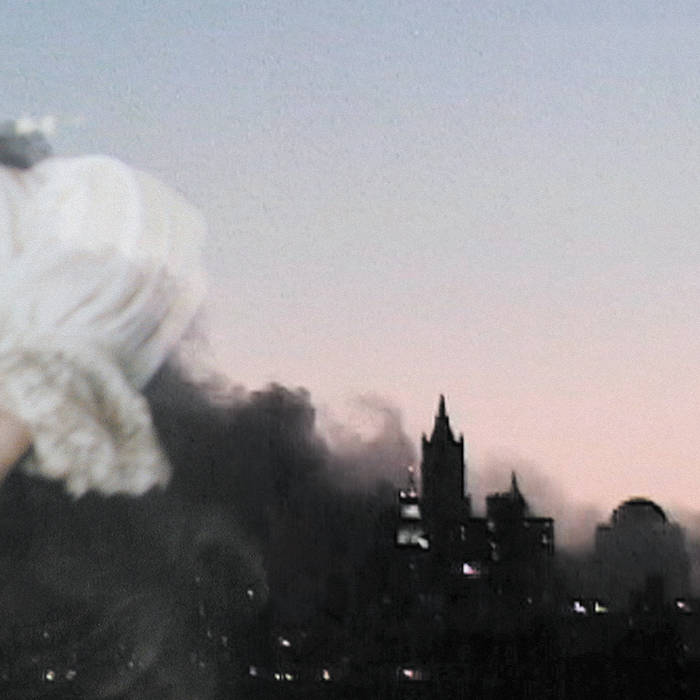
pictured: the cover art of William Basinki’s Disintegration Loops
 Daniel Massett
Leave a comment