The loss of beauty leads to despair. This is the condition of our world without art and it is precisely what Tolstoy found when, confronted by the many competing definitions of beauty, he despaired of its existence and the effect this would have on his art.
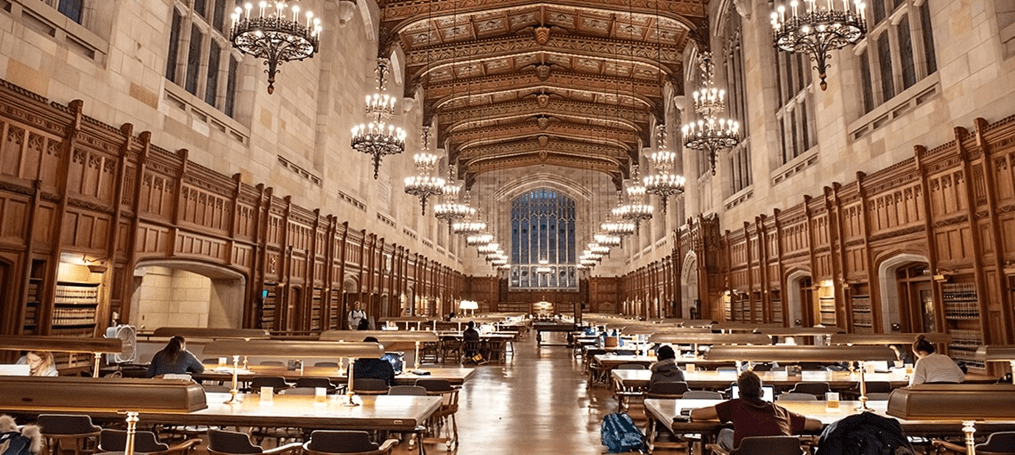
It’s actually difficult to understand this as a modern person because we are completely engulfed by ugly art. Not only art, but also anything made that could and should be beautiful is now not. As a teacher, I think a lot about classrooms and school buildings, with their low ceilings and intense fluorescent lights, their walls covered with ugly patterns of ugly-colored paint, their tiled floors. Where classrooms and academic buildings once, at their best, were designed to look like this, the University of Michigan Law School library:
they now looks like this, a typical contemporary library at the same university, Michigan, as the above library:

What is the difference between these two rooms? Why does one room, with its deep brown woods, its vaulted ceiling, its chandeliers, make one think of how pleasant it would be to study, how good it is to learn and commit oneself to learning, while the other, with its low ceilings, trademark fluorescent lights, ugly mass-produced tables and chairs, and puke green walls, make you feel ill-at-ease? The difference, I would argue, is that one was designed merely for its function (both are places of learning, broadly-speaking), while the other is designed for that same function but also for beauty. When beauty is not considered, ugliness and despair follow. You would want to leave the modern classroom as soon as the class period ended. You would want to stay inside that library until they forced you out. Why is that? What exactly is beauty, and what effect does it have on the human person?
What is Beauty?
Let’s return to Tolstoy. In his work, What is Art?, Tolstoy examines the myriad definitions of beauty, and, despairing of finding common ground between them, tosses up his hands and decides that beauty does not exist. He has become trapped within the cave. This loss of the reality of beauty leads Tolstoy to conclude that, if fiction isn’t simply for writing something beautiful, which it can’t be, then it must be for teaching moral lessons, and, since beauty doesn’t exist, he lambasts works of the past that don’t possess a strong moral lesson, such as his own masterpieces War and Peace and Anna Karenina, as well as works by Beethoven, Shakespeare, Dante, and many others besides.
It’s important to note that, just because there are many competing definitions of “beauty,” this in no way means that beauty does not exist. People could have many different definitions of “peanut butter”. One person might say they’re the things that you wear on your face that help you see. One might say that its peanuts ground up so finely that the oil releases, making the peanut spreadable on bread. One person might say it’s the briny water that surrounds the landmasses of planet Earth. But these sundry definitions don’t mean that “peanut butter” doesn’t exist! It only means that many of those definitions are wrong, and only one is right. The point being, many philosophers have simply been wrong about their definition of “beauty”.
Beauty is one of those things that we all know exists until that knowledge is beaten–or should I say, educated–out of us. One of the great “common sense” philosophers, St. Thomas Aquinas, defines beauty as “that which, when seen, pleases.” Now, there’s a start! This strikes one as being patently obvious, and yet, compared to the modern declaration that “Beauty is in the eye of the beholder (and, the implication being, it therefore doesn’t really exist outside of the individual’s mind),” Aquinas’ definition has the wondrous quality of actually claiming beauty does in fact exist. It is a thing outside of oneself that pleases those who behold it. Great!
But he goes further, trying to define the core of beauty. “”For beauty three things are required: this first is integrity, or perfection; (second) due proportion, or harmony; and the third is splendor.” Again, this isn’t to get too lost in the weeds, but essentially, these means that there is a core to beauty. There is a certain perfection to it (so, a song doesn’t have a sour note, or at least, no sour note/dissonance without adequate reason for it being there); a harmony (so a work of fiction will harmonize, say, on several layers–character, plot, symbolism, theme, etc), and splendor, how bright it is, how deep (so a work of fiction whose theme is, say, the nature and meaning of suffering–The Brothers Karamazov–is going to have more splendor than one whose theme is a fairly surface-level examination of love and friendship–the Harry Potter series; or, to compare apples to something more like apples, the examination of good and evil in The Lord of the Rings has far more depth and splendor than the examination of the same in the Harry Potter series).
Another way of applying this, and perhaps a better way, is to say that if a work of fiction has integrity (all of its character arcs, plot, and theme, etc. are satisfied) and harmony (all these things work in conjunction with one another, with nothing out of place), then a deep splendor, a kind of radiance, shines through–that feeling one gets of the depth of beauty when one closes Anna Karenina or The Iliad or some other beautiful work. A kind of deep joy is felt as the human heart and mind connect with the objectively beautiful, and we can deepen even more this splendor through contemplating a great work and understanding it more deeply for its richness.
And this definition gives much flexibility to art to capture some “fragment” of the beauty of God. As Jacques Maritain says in Art & Scholasticism, “There is not only one way, but a thousand and ten thousand ways in which the notion of integrity, or perfection, or achievement cah be realized. The absence of head or arm is a lack of integrity very noticeable in a woman, and slightly noticeable in a statue, no matter how disappointed N. Ravaisson may have been at not being able to complete the Venus de Milo. The least sketch of da Vinci, let alone of Rodin, is more final than the most finished of Bouguereau. And if a Futurist thinks fit to give only one eye, or a quarter of an eye, to the lady whom he is portraying, no one denies his right to do so, one only asks-that is the whole crux-that this quarter-eye be all the eye needed by the said lady ‘in the given case.’” A beautiful object captures some part of beauty particular to itself, yet still in relation to that eternal beauty of the Divine Being. There are endless characters, themes, plots, and so on that could make for a beautiful work of fiction. Beauty is larger than any one work of art, and larger than every work of art ever created or to be created put together, as beauty is ultimately God Himself.
We can see beauty most clearly, it seems, when we are merely living in reality. Nature is one of the great works of art, and simply looking up at the night sky, or standing on top of a mountain in the woods, or looking at the sun set over the ocean, is enough for us to feel beauty’s strong pull over our hearts and souls. It’s also clear to see how leads the heart to God–the beauty of these things very nearly wounds us. We are reminded of what we are made for. We feel the urge to throw away our phone, hug the people we love in such a way that they understand how deeply we love them, to live a meaningful life. It is the “wounding thing,” as Benedict XVI says. It wounds us because it reminds us of everything we so desperately, deeply want–to live in the spirit of God, to “choose Life, not Death” as Moses says to the Israelites (afterwards teaching them a song to remind them always of this choice–he knows he must appeal to their heart, and that truth found within beauty is of deepest power).
Despair
I don’t want to linger long on ugliness, but it is also noticeable when we compare it to something ugly, like modern art, which rarely possesses beauty. As such, no one is called to any sort of higher life when beholding it. To suggest that someone was put into the raptures of beauty while looking at a Jackson Pollack is absurd beyond absurdity, because it would be a total rejection of beauty and human nature.
Ugliness leads to despair because we aren’t treated as spiritual beings. As von Hildebrand writes, there was once a time where even utensils were small reminders of our humanity, our strange nature of being both matter and spirit. As Pascal says, ““Man is only a reed, the weakest in nature, but he is a thinking reed. There is no need for the whole universe to take up arms to crush him: a vapour, a drop of water is enough to kill him. but even if the universe were to crush him, man would still be nobler than his slayer, because he knows that he is dying and the advantage the universe has over him. The universe knows none of this.” We once created things that were little reminders of this simply by being useful and beautiful. Alice von Hildebrand writes of even children’s toys once being “little masterpieces,” where now children only recieve mass-produced, ugly, plastic toys. And again, a cheap plastic toy is nothing compared to the horrors of looking at an AI-generated video.
Beauty draws us in. It acts on us, and we can meet that act. Ugliness does little to act on us, certainly at our highest, most spiritual level. We must act on it to make any sort of meaning out of it.
Moreover, we used to create art that far more powerfully and directly spoke the same truth.
The ultimate end of all finite beauty is to manifest, even if in fragments, the infinite beauty of God.
– Rev. Robert E. McCall, S.J.J.
What is Art?
An old distinction is useful when thinking about the question of art. People once distinguished between the “arts” and the “fine arts”. Remnants of this distinction still exist today. My degree is a “Master of Fine Arts”. But few could really explain the difference between the arts and the fine arts, and this collapsing of distinction has led, as it always does, to not insignificant confusion.
An “art” is anything that is made. It is an art to build a house, or cook a meal, or put the sole on a shoe. It is an art to make a table, or to make the silverware that is set on the table. A “fine art” is anything that is made with the express purpose of being beautiful. A “fine art” is a “thing of beauty…a joy forever.” We have art forms that have been cultivated for millenia around this idea, from dance to theatre to poetry. From time to time, a new artform emerges, such as the novel (though there were novels in antiquity, the “modern novel” began in the 17th century, often with Don Quixote being named the first modern novel) or cinema, and the jury is still out on if video games are fine art (a question I’ll attempt to answer below as a huge fan of video games and art).
Again, the idea of primary and secondary purposes comes into play here. A spoon need only be a spoon. A good spoon is one that can ladle soup from a bowl into your mouth. A bad spoon is one that cannot. “Arts” have their primary purpose in something other than beauty. And yet, they can still possess beauty to greater and lesser degrees. Dietrich von Hildebrand, in Aesthetics, writes on this so well that I feel I should quote him in full:
[U]ntil the beginning of the nineteenth century and the triumph of the machine, culture had not yet been strangled by civilization. The expression of the spirit, the gift of giving form in such a way that was not practically indispensable, penetrated all the practical spheres of life up to that time. A knife should not only cut well; it should also possess a noble form. A chair should not only be comfortable and solid; it should also be beautiful, in fact it should sooner be a little less comfortable than be sober and prosaic. Practical life as a whole possessed an organic character and was therefore united to a special poetry of life. Related to this was the penetration of life by culture.
But as the practical life of the human being was robbed of its organic character and was mechanized and thereby depersonalized, so too the poetry of practical life was lost. The practical requirements in residential homes became a prosaic matter that was radically detached from the affective and intellectual life that we lead as persons. Railway stations, factories, airports, filling stations, and department stores were built to serve technical, neutral purposes. Cities like Phoenix and Tucson in Arizona largely consist only of such buildings, which are completely separated from the residential homes. In all these buildings, it is clear that there is no link between practical requirements and the spiritual requirements of the human being. The latter are neutralized in such a way that they no longer offer any artistic stimulus for the architectural shaping of these buildings and rooms. The building itself becomes an object of technology.
-Dietrich von Hildebrand, Aesthetics, vol. 2
So, a practical “art” can nevertheless have beauty, and yet, in our mass-produced era, they typically do not possess much. And yet, the lack of beauty in practical arts is one of the great causes of despair in our times, because things that could remind us of our spiritual natures no longer do. A spoon is just a utensil. A classroom is just a space for receiving information. A city street is just a set of lanes for getting from one ugly commercial building to the next, with the potential to see some ads along the way. We are never reminded by these things of our spiritual nature, though in a better world, we would be, and we once were.
The fine arts, on the other hand, pursue beauty above all else. If they are useful (say, a song written for a film score, or a painting to be displayed in a political building, or The Aeneid being used to secure a kind of political narrative of Rome), that is all well and good, but they do not need to be useful. They need only be beautiful.
The beginner fiction writer should be aware that art must lead the way to reforging the connection to the Divine through the Via Pulchritudinis–The Way of Beauty. The connection between fiction and truth will be explored in the next chapter. For now, it is worth saying that a work of fiction that has great plot, deep characterization, and great language–to oversimplify something that will be explored later–is what makes fiction beautiful.
 Daniel Massett