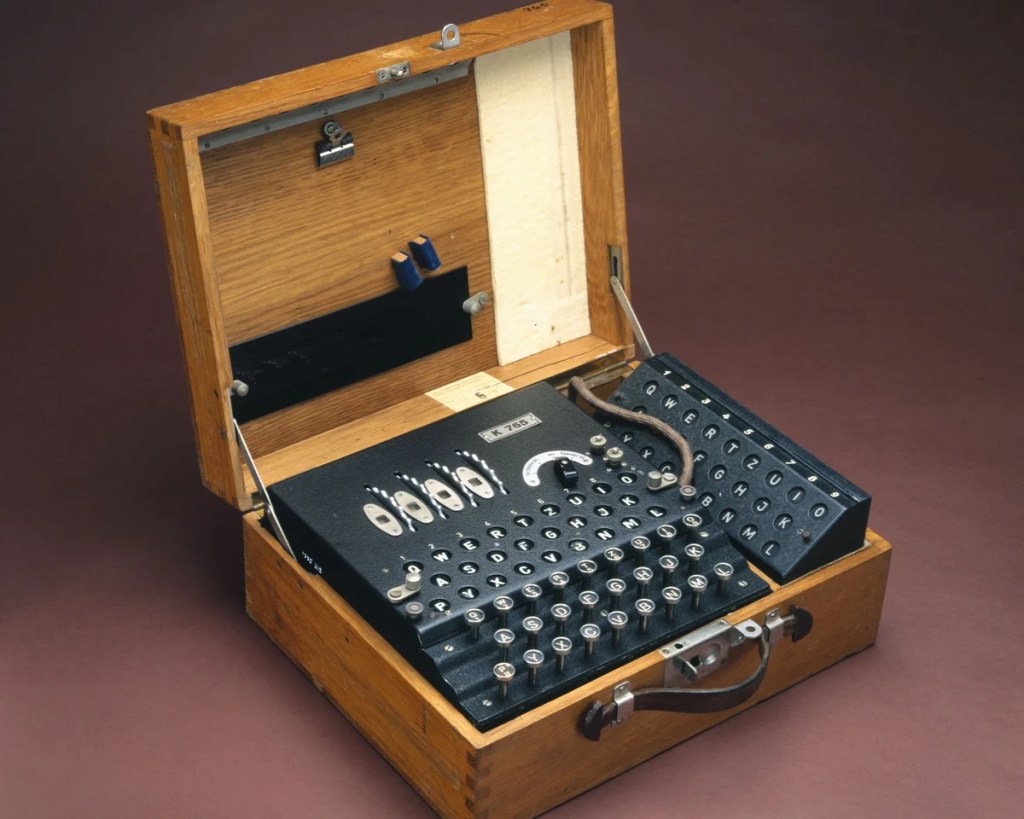
One of the most persistent battles I’ve fought as a fiction writer is against the English Major mind. What I mean is that, frequently when I write, my mind gravitates toward thinking about what the story I’m writing “means”. The meaning of a text, or of any work of art, is what we’re taught to focus on in the setting of a literature class, or in any discussion of art as a whole. We, culturally, have taken art as essentially a form of rhetoric, conceptualizing fiction as basically an essay written in code, and the student of literature, like Alan Turing, must break that enigma. Once the code is cracked, the literature reveals itself, and once its message is understood, the reader can happily move on.
This framing of fiction as rhetorical extends out to all works of art. In our own day, we make very piece of art about politics, since politics is basically all anyone talks or thinks about. So we analyze everything through the rhetorical lens of what its message is politically.
However, you’ll find that often in interviews, artists are asked what their artwork “means,” and the question, bafflingly it seems to us, leaves them at a loss for words, perplexed. They may even deny ever thinking of such things. But worse yet, as I’ve written about elsewhere, some artists are over-eager to explain their works, to the point where the explanation, the rhetorical message of the work, seems more important to them than the art itself.
The Intuitive “Yes”
Annie Dillard, in her wonderful book The Writing Life, returns again and again to images of artists who have no idea what the outcome of their art will be, what people will make of it. They describe feeling like they are simply pulling on a string to see what comes at the end of it, or, in the famous example she provides of the stunt pilot, that he is, essentially, hanging on for dear life, keeping the sun on a certain side of his face, and so on. She portrays art as process-driven, as giving in to a certain experience, regardless of the outcome.
But what exactly is this experience? George Saunders seems to give the answer in his book on craft, A Swim in the Pond in the Rain. It’s worth quoting in full, which I will pull from a piece he wrote in The Guardian that goes through the exact analogy:
A guy (Stan) constructs a model railroad town in his basement. Stan acquires a small hobo, places him under a plastic railroad bridge, near that fake campfire, then notices he’s arranged his hobo into a certain posture – the hobo seems to be gazing back at the town. Why is he looking over there? At that little blue Victorian house? Stan notes a plastic woman in the window, then turns her a little, so she’s gazing out. Over at the railroad bridge, actually. Huh. Suddenly, Stan has made a love story. Oh, why can’t they be together? If only “Little Jack” would just go home. To his wife. To Linda.
What did Stan (the artist) just do? Well, first, surveying his little domain, he noticed which way his hobo was looking. Then he chose to change that little universe, by turning the plastic woman. Now, Stan didn’t exactly decide to turn her. It might be more accurate to say that it occurred to him to do so; in a split-second, with no accompanying language, except maybe a very quiet internal “Yes.”
He just liked it better that way, for reasons he couldn’t articulate, and before he’d had the time or inclination to articulate them.
“He just liked it better that way.” Imagine giving that answer to your high school AP English teacher when they asked you why Melville spent an entire chapter talking about the whiteness of the whale instead of cutting it altogether. And yet, this seems the truest explanation of why.
Learning to See
Now, I have been listening a lot to the band Geese and Cameron Winter’s solo material. I came to them through them opening for Vampire Weekend in Philly. Something I think a lot about is their song “Long Island City Here I Come” from their recent album, Getting Killed. That whole song to me feels particularly inspired, as though they just continually said yes to stranger and stranger escalations in the music that, nevertheless, felt just right to them. One of the most hilarious and inspiring moments is when Cameron Winter sings “I’m about to kick your ass up and down this street” then proceeds to mutter “Here I come” over and over again and let out strange vocalizations for several minutes straight. It’s strange, funny, a little deranged, totally awesome, and, it would seem, deeply inspired, and inspired by a “Yes” that the entire group of musicians, or at least, some of them, must have felt when that moment first emerged.
The above-mentioned Vampire Weekend has tons of moments like this in their music too. I mean, from the jump, who would have thought of combining pop music, African rhythms, and Western classical influences into a single thing? I actually don’t believe it could be totally thought up. It had to be felt. In their song “Mary Boone,” off their most recent album, a sitar, an elegant piano riff, a hip-hop-style backbeat, some strings, and a choir, all play together at once after each chorus. It really shouldn’t work. But it totally does.
In their song “Ya Hey” (which features some chipmunk vocals that, again, really shouldn’t work, but do), they pretty explicitly reference this kind of bizarre genre-mashing in the bridge:
Outside the tents, on the festival grounds
As the air began to cool, and the sun went down
My soul swooned, as I faintly heard the sound
Of you spinning “Israelites”
Into “19th Nervous Breakdown”
Here, this very mixing of incongruous sounds is attributed to God, here represented as a DJ at a festival. They’ve touched something deep, something like reality or Being itself or God, in this mixing.
Now, I’ve spoken only to really over-the-top, explicitly “inspired”-feeling moments in song, but the point is, all of the song, every moment, must feel touched in this way, the musician must feel that “yes” at each moment of the song. Often, especially at first, it may be only the musician themself who feels the “yes”. I think here of Jack White, who, now famously, showed the “Seven Nation Army” riff to a friend, who was unimpressed. It is, in the grand pantheon of riffs, taken on its own, really not the greatest thing. And yet, White simply felt differently. He heard the riff and felt the internal yes, and pursued it to a song that is now an iconic anthem.
Similarly, you might be a musician. One of the things that may young artists do is write music that sounds like the musicians they like, but ultimately, they don’t find that satisfying. Why? Well, they chased someone else’s intuitions, vision, inspiration, “yes”, not their own. I love Jack White, but when I write songs, I stay away from riffs. They simply don’t excite me when I write them. Now, each song, story, painting, whatever, has its own craft and must be followed through on by the artist according to their own intuition, meaning one day, a riff may strike me as a “yes”. It simply hasn’t happened yet, but one should remain open to possibility. This is also why people a bit more tuned in to art are repulsed by music that sounds too much like music that came before, or like a pop-form of that music that is packaged to sell to the radio and Spotify and all that. It is clearly not the vision of the artist, but a stolen vision, and a decidedly lesser version of that original vision.
Back to Stories and Rhetoric
All this is not to say that stories, songs, and any artwork, doesn’t have meaning. I think they actually tend to have many complimentary meanings, particularly if they’ve struck beauty, being, reality, since reality can be looked at from a number of different angles to find a number of true, complimentary takeaways. Some saints were kings, some went to live in the desert. This is all only to say that these meanings are best discovered and fully worked out on the other end, often without the artist. Nothing ruins a work of art as readily and with as much good intent as pushing the meaning/message of the story so far forward that it ruins the inner workings of the art itself. I think of Chesterton’s White Horse, which is a really fun epic poem that then has to end with Alfred having a vision that the pagans will return, but with pens instead of swords! It flattens the entire poem to basically a message directed at barbaric academics, which, even if an important message, flattens the story. Or, similarly, moments like the girlboss moment in Avengers: Endgame, where for reasons inexplicable, all the female superheroes and none of the male ones have to carry the infinity gauntlet for a few moments, forcing a message into a scene at the expense of the scene itself.
As an artist, it is completely damaging to your art to be too focused on a rhetorical dimension of your work, because it will kill the “yes”. I found this moment from a Cameron Winter interview in Far Out:
“I feel like there’s nothing worse than going into a song, like ‘I have something to say with this song’.”
He continued, “Because then it’s just too much, like you’d end up writing a song that’s all about some super-specific issue – they don’t age very well, those songs. The clearer the message, sometimes, the less powerful it can come across.”
He added jokingly, “It doesn’t come across artistically. You should just make a tweet, or something.”
However, the singer-songwriter admitted, “Sometimes I do have something to say, unfortunately,” before admitting, “I get self-conscious about being too on the nose, and then if I’m not on the nose at all and it’s just like Goobledee-Girk, Lewis Caroll, horse-talk. Then I have to reverse engineer the message.”
He is exactly right. If you have something to communicate, write a tweet, or an essay. Essays are wonderful! But a song shouldn’t be an essay, a story shouldn’t be an essay.
The truth is, it seems to me, that while art can communicate truths, it does this by essentially capturing something deeper than can be expressed in, say, a string of formal logic, a speech, a debate, whatever. Those things are all well and good–all well and great, actually–but art taps into a deeper vein, where an entire fabric of truths and intuitions became a rich tapestry married to an expression given material form (a painting, a song, a narrative) that is beautiful. We can then go back and pull on some of those strings to explain those truths, but the artist is the person who is simply working their art (trying to make a painting look just right, trying to have a certain scene really capture the horror of loss, trying to give someone a character arc that makes sense, etc.). If they’ve written something “true,” something that gives them an intuitive “yes,” then, having touched the Real, it will be able to be dissected and discussed in hindsight, as it were.
Tuning into the “Yes”
The goal of the artist, then, is to tune into the “Yes”. I believe there are periods of learning where other things should be focused on. Certainly, a beginner fiction writer should learn the art of plots, character arcs, sentence structures, word choice, and so on. They should read the classics, the great works, and try to take them apart and see what makes them tick. They should workshop and learn from teachers (I’ve actually found one of the great benefits of workshopping is that readers pick up on moments where I wasn’t feeling the “Yes”–they could sense it, and could tell something about that part just didn’t work, which helped me tune into the intuitive sense more). I think people should read philosophy and try to come to a deeper understanding of art in general. But when really trying to work, trying to write, let go, lock the English Major out of the room. Lock the Alan Turing out of the room. Artmaking isn’t a code to crack, but a dance to dance. So go for the “Yes”, and revise and revise until the entire story feels like one long, protracted “YES!”
 Daniel Massett